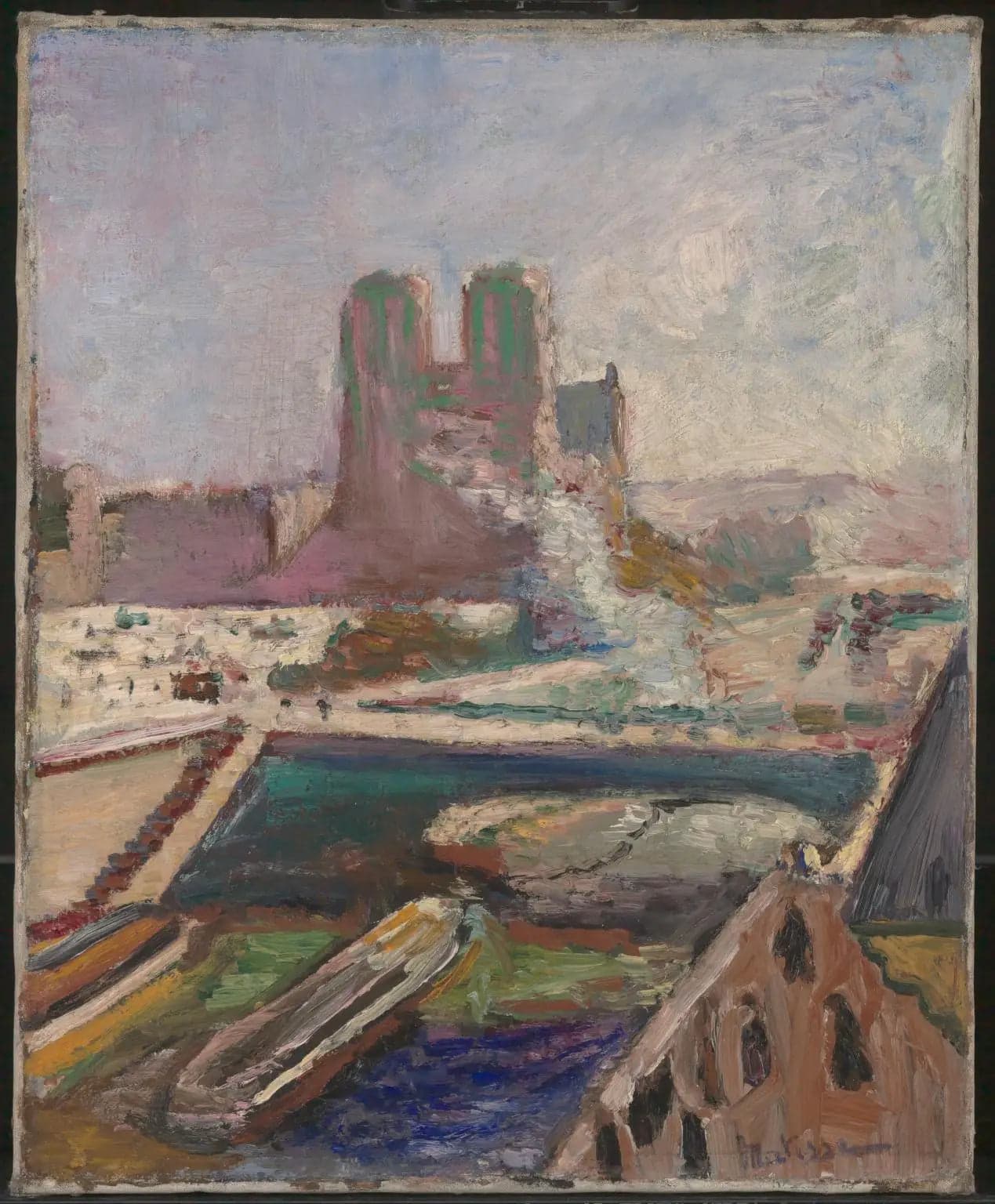
Notre-Dame
- Original dimensions
- 37.5 x 46 cm
- Museum
- Tate
- Year
- 1900
Scene depicted
The painting “Notre-Dame” reveals a unique atmosphere, where the majesty of the cathedral blends with the tranquility of the water, capturing the sweetness of a suspended moment. In the distance, one can almost hear the murmur of the waves and the song of the birds, while the lights dance on the Parisian cobblestones, a tribute to the timeless beauty of this architectural symbol.
Historical context
Created at the end of the 19th century, this major painting resonates with the artistic effervescence of Fauvism , a movement that celebrates chromatic freedom and the subjectivity of emotions. Located in Paris, at the heart of France, Notre-Dame depicts the iconic cathedral that embodies French architectural heritage. Currently exhibited at the Tate , this painting measures 37.5 x 46 cm and continues to move visitors.
Place in the artist's career
“Notre-Dame” stands as an important pillar in Matisse's career, marking a period of artistic maturation. Alongside works such as “The Dance” and “The Joy of Life,” this painting testifies to his stylistic evolution, oscillating between abstraction and figuration, and rhythmically pursuing a new visual harmony.
Anecdote
“Color must be the reflection of an emotion.” This quote from Matisse captures the very essence of his masterpiece . Inspired by a sunny morning by the Seine, he captured the light and shadow of the cathedral, creating a painting that speaks to the soul of the viewer, offering a spiritual and visual communion.