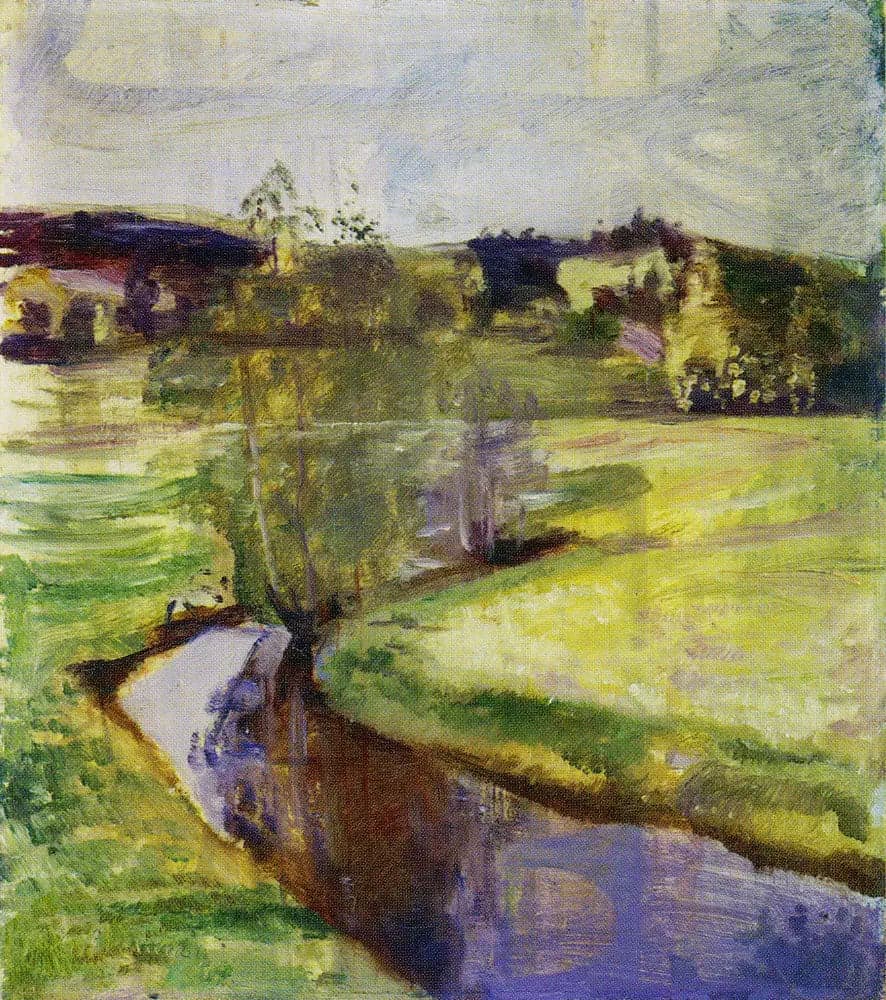
Norwegian Spring Landscape
- Original dimensions
- 46 x 52.5 cm
- Museum
- Not specified
- Year
- 1890
Scene depicted
The painting “Norwegian Spring Landscape” by Edvard Munch pays homage to Norwegian nature and its renewal. It features verdant hills, vibrant under the caress of the sun, whose shimmering reflections in the rivers add a touch of magic to this lush nature. The fluid forms of the canvas evoke a peaceful world, inviting contemplation. Each brushstroke testifies to a sincere admiration for the landscape, transcribing a message of hope and serenity.
Historical context
Created in 1890, this superb painting echoes a pivotal time, representative of the expressionist movement that emerged in Norway. Edvard Munch chose a lush landscape, drawn by the wild beauty of his homeland, infusing his canvas with a breath of spring. Although the work is not currently displayed in a specified museum, its dimensions of 46 x 52.5 cm testify to an intimate format, perfect for transporting the viewer into this vibrant painting.
Place in the artist's career
“Norwegian Spring Landscape” is at the heart of Edvard Munch 's career, symbolizing a turning point towards a bold mastery of colors and emotions. Situated between “The Scream” and “The Dance of Life,” this painting reveals the stylistic evolution of an artist in search of inner expression. Here, light and emotion are fully integrated, creating a remarkable composition in Munch's work.
Anecdote
“Every sunset is a painting that one creates with their soul,” Munch once said while contemplating a landscape on a road trip through Norway. This thought perfectly summarizes the inspiration that illuminated the genesis of this masterpiece , capturing a pure moment when a spring morning envelops the valleys in light and softness. Thus, the painting becomes a reflection of the painter's soul, revealing both his joys and his torments.