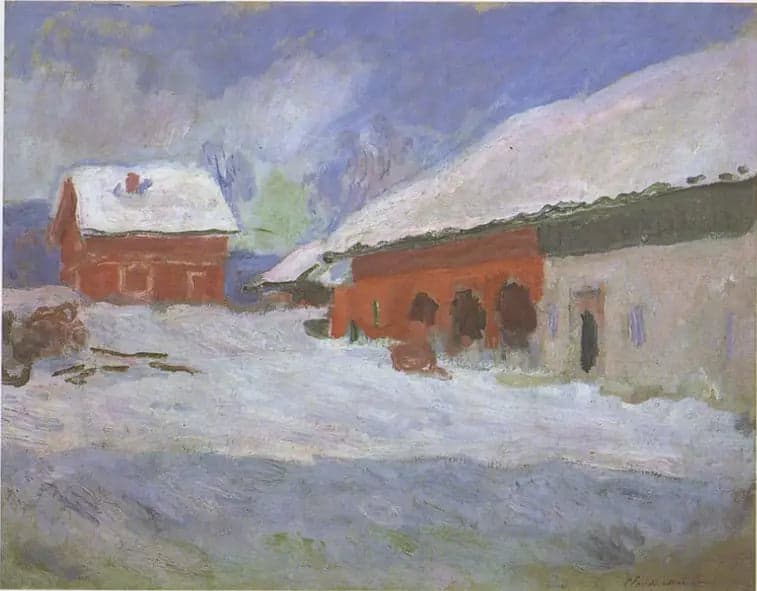
Norway, the red houses at Björnegaard
- Original dimensions
- 81 x 65 cm
- Museum
- Marmottan Monet Museum
- Year
- 1895
Scene depicted
The painting Norway, the Red Houses at Björnegaard depicts a serene tableau of life within a small Norwegian village. This rural setting, caught in the golden and enveloping light, immerses us in a universe where time seems to stand still. The houses, in a bright red, stand proudly in a landscape embraced by lush green hills. Each brushstroke of Monet tells the story of a place, marrying architecture and nature in a ballet of colors that evokes a nostalgic sweetness.
Historical context
Year: 1895 |BRK| Museum: Marmottan Monet Museum |BRK| Dimensions: 81 x 65 cm
Place in the artist's career
This painting stands at the pinnacle of Monet's career, representing a culmination of his exploration of light and shadows. Echoing Impression, Sunrise and The Saint-Lazare Station , these two other paintings show a technical and emotional evolution. Norway, the Red Houses at Björnegaard asserts itself as a major masterpiece, marking his brightest and most poetic period.
Anecdote
Monet once stated: "Art is the most beautiful of illusions." It was in the heart of a spring morning, bathed in the softness of the northern light, that the idea for this painting came to life. The red houses shimmer under the sun, reflecting the soul of the Scandinavian nature. This painting is the materialization of a fleeting moment, an immortalization of a lived emotion that resonates like a love song to the cold landscapes.