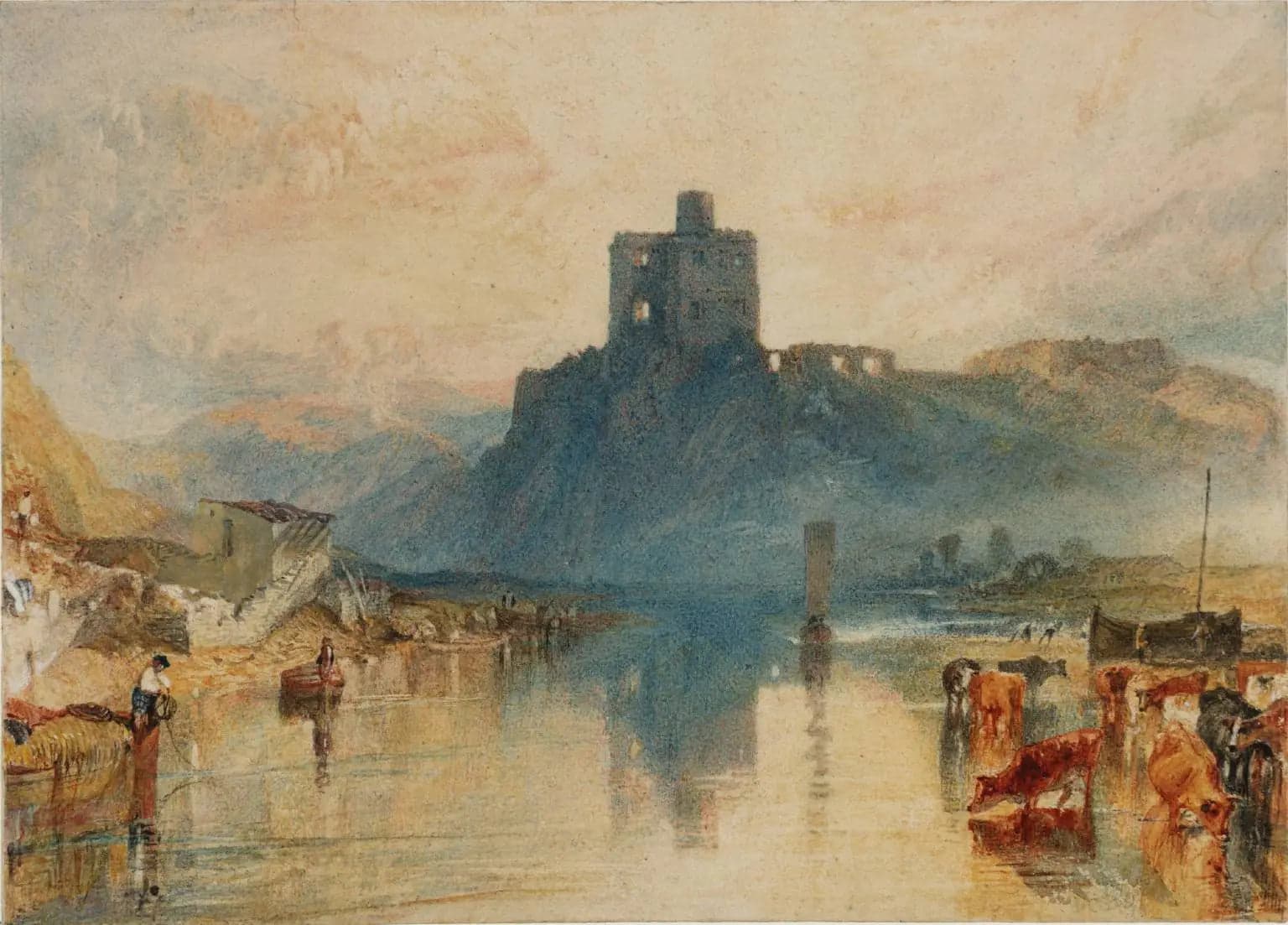
Norham Castle, on the River Tweed
- Original dimensions
- 216 x 156 cm
- Museum
- Not specified
- Year
- 1822
Scene depicted
This canvas , Norham Castle, on the River Tweed, presents a fascinating panorama where the historic fortification majestically emerges from the morning mists. The gentle waves of the Tweed blend with the mystical atmosphere, creating a play of subtle lights, while the reflections of the castle on the water add a poetic dimension to the whole. Turner, with his mastery of nuances and light, manages to transport the viewer to a time where past and present intertwine.
Historical context
Created in 1822, Turner’s painting evokes the majesty of Connaught Castle, a historic fortress located on the banks of the Tweed in the picturesque cradle of England, the Northumberland region. In the context of Romanticism , this pictorial work embodies the principles of this movement, standing out with a unique sensitivity to nature and the cultural heritage of the British landscape. The canvas , now preserved in private collections, displays impressive dimensions that enhance its visual impact.
Place in the artist's career
This pictorial work fits into a period of artistic maturity for Turner, reflecting his evolution towards increasing abstraction through landscapes. Both as a key step preceding his late phase where color and light took precedence, paintings such as The Fighting Temeraire and Rain, Steam and Speed illustrate this journey, marking his transition to bolder compositions.
Anecdote
“The light of a misty morning, the shadow of a castle on the peaceful water, that is where inspiration awakened in me.” J. M. W. Turner was said to have been inspired by this scene, captivated by the blend of tranquility and vastness. The moment of creation of Norham Castle, on the River Tweed was a dance between emotion and technique, where each brushstroke told a story.