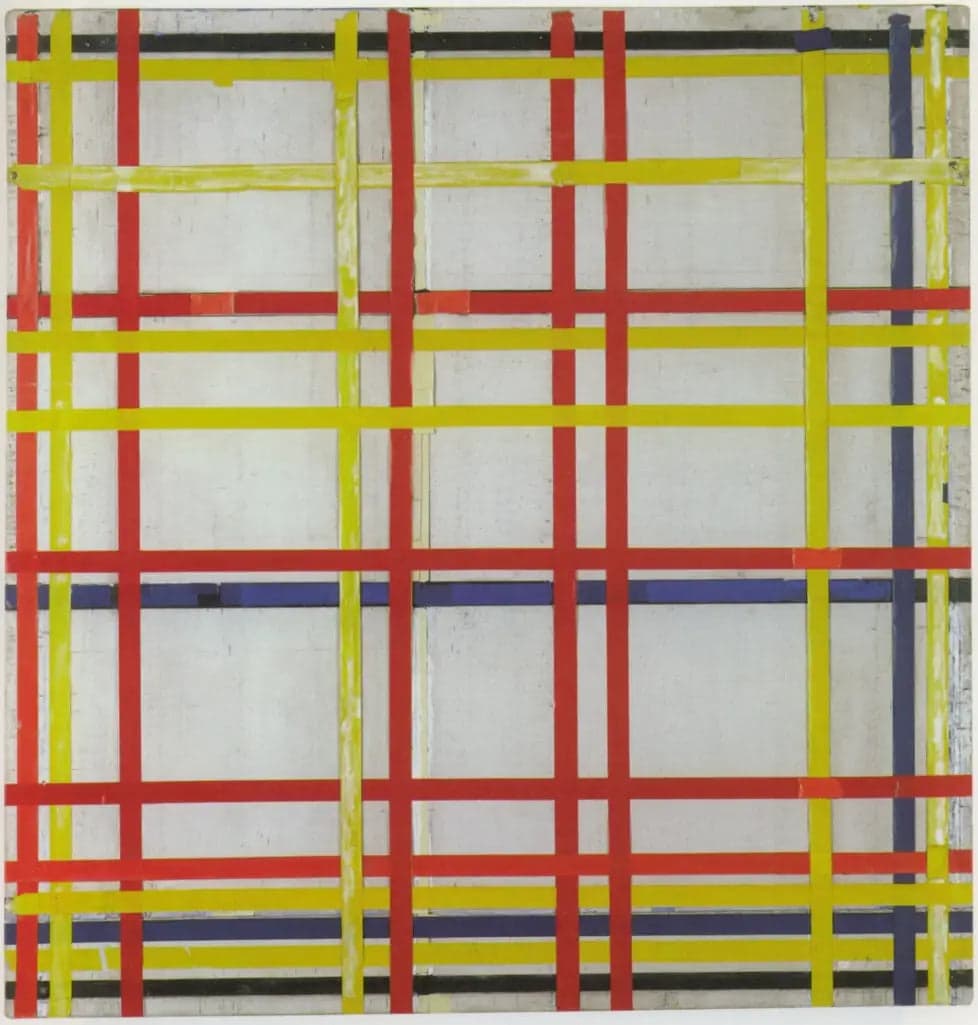
New York City I
- Original dimensions
- 115.2 x 120 cm
- Museum
- K20
- Year
- 1941
Scene depicted
In New York City I , Mondrian illustrates the vast metropolis through a bold geometric composition, a balanced juxtaposition of rectangles and primary colors. This pictorial representation aims to express an abstract reality, where the perpetual movement of the city is implicitly felt. Each element of the painting interacts, creating a chaotic harmony that pays tribute to the vitality of New York.
Historical context
Year: 1941 |BRK| Museum: K20 |BRK| Dimensions: 115.2 x 120 cm
Place in the artist's career
New York City I represents a turning point in Mondrian 's career, a symbol of his stylistic peak. In his evolution, this painting can be compared to other works such as Broadway Boogie Woogie and Composition II in Red, Blue, and Yellow . These paintings show how his quest for pure abstraction is reinforced with an increasingly liberated approach to forms.
Anecdote
“The city is a series of lines and shapes, a rhythm that only painting can capture,” said Mondrian . It was a spring morning in 1941 in New York that the artist, fascinated by the lights and shadows of the skyscrapers, sketched the first ideas for this masterpiece . The invocation of architecture and color gives his canvas a vibrant energy.