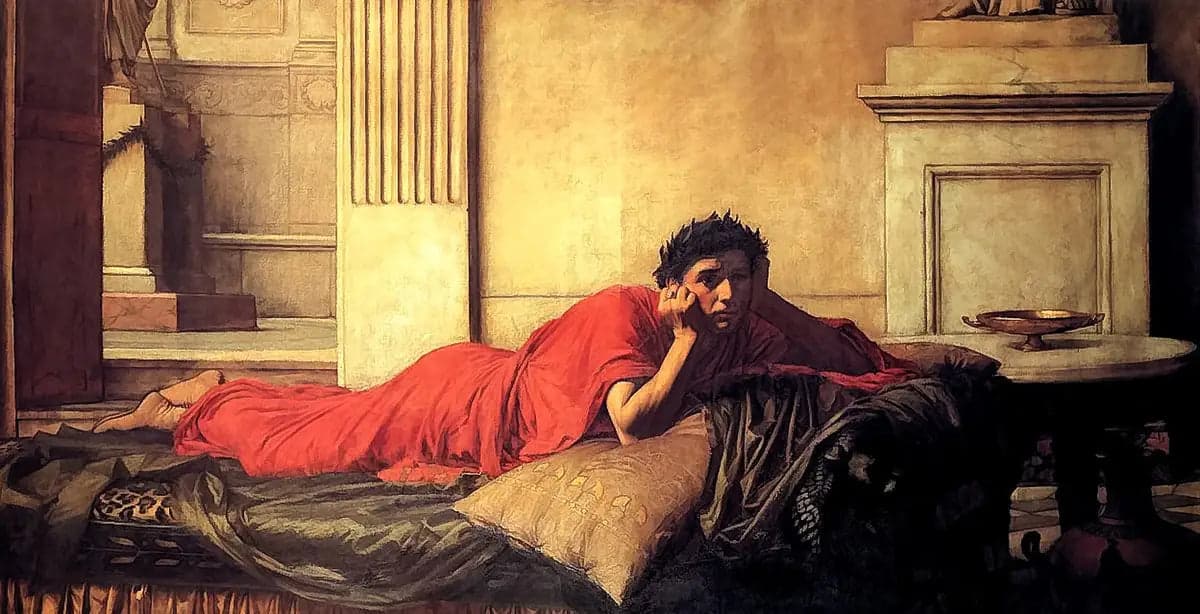
Nero's Remorse After His Mother's Murder
Scene depicted
This painting immerses the viewer in the torments of Nero, a Roman emperor, consumed by regret after ordering the murder of his mother, Agrippina. This pictorial work evokes complex emotions: sorrow, guilt, and pain. The viewer's gaze is captured by the intensity of the expressions that convey the devastating remorse of the man at the height of his power.
Historical context
Created in 1878 in London, this painting is emblematic of the Pre-Raphaelite artistic movement. At that time, England experienced a resurgence of interest in classical art and the idealized beauty of mythological and historical themes. The original painting is displayed in the Leeds museum collection, where it testifies to a golden age and a refined sensibility. Its dimensions, 122 cm x 183 cm, make it a large-scale masterpiece.
Place in the artist's career
With The Remorse of Nero after the Murder of His Mother , Waterhouse reaches a stylistic peak in his career. He stands out for his skillful use of light and rich colors, while connecting to themes of melancholy. This painting can be paralleled with Sleeping Beauty and Ulysses and the Sirens , two paintings that reveal an evolution in his techniques, moving from romantic exploration to deeper introspection.
Anecdote
"Beauty is the only truth accessible through art." This quote from Master Waterhouse resonates particularly when exploring the genesis of the masterpiece . Inspired by a dream on a misty morning, he recalls a London alley, shaded by withered flowers. It is in this moment that the idea for this canvas came to him, blending beauty and tragedy in a poignant composition.