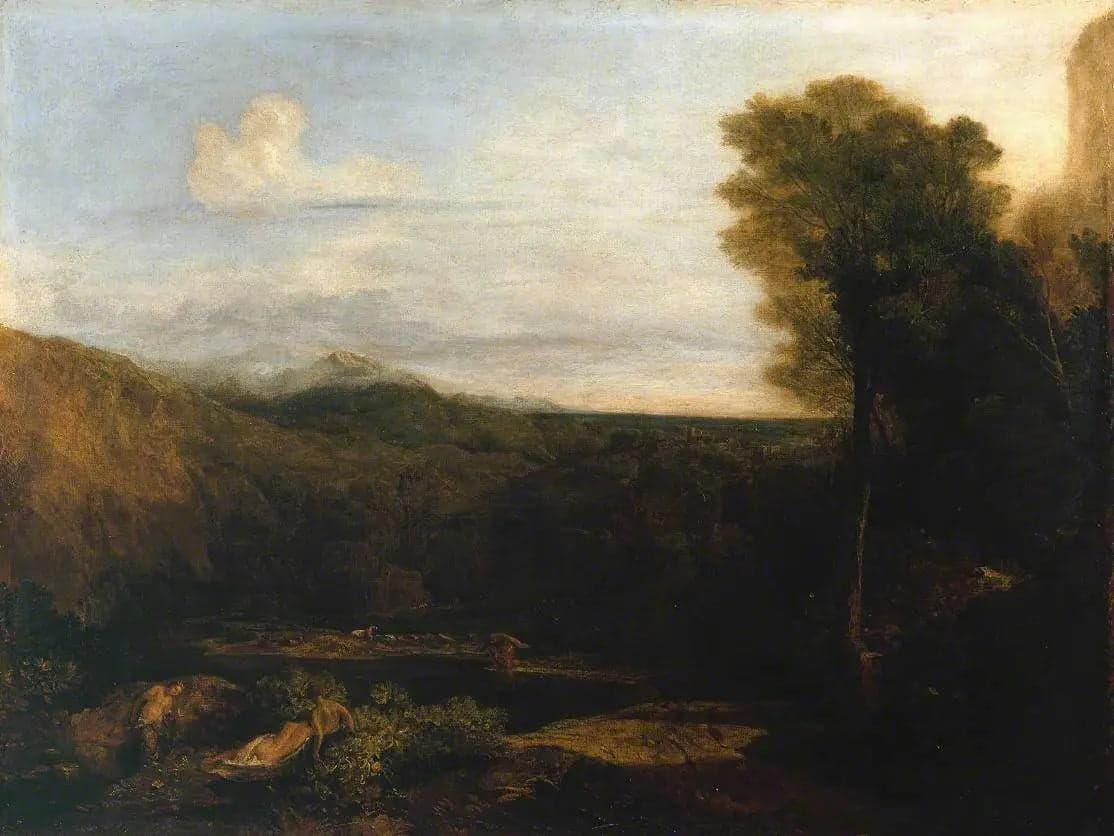
Narcissus and Echo
- Original dimensions
- 117 x 86.5 cm
- Museum
- Tate
- Year
- 1804
Scene depicted
In this masterpiece, Turner illustrates the tragic myth of Narcissus, a young man captivated by his own image reflected in the waters. Echo, a nymph, embodies unrequited love and suffering. This pictorial work evokes ephemeral beauty and themes of love, loss, and isolation, while capturing the delicate movement of the figures through refined details.
Historical context
Created in 1804 in early 19th century England, Narcissus and Echo is part of a nascent romantic movement that valued nature and human emotions. Turner, an emblematic figure of this movement, stands out for his ability to capture light and movement through his canvas . Today, this painting is preserved at the Tate , testifying to the excellence of British art from this period.
Place in the artist's career
Narcissus and Echo represents a crucial step in Turner’s career, marking the beginning of his exploration of emotional landscapes. This painting can be seen as a transition to more abstract works, especially in comparison with The Fighting Temeraire and Rain, Steam and Speed , where narrative intensity and light management become even more pronounced.
Anecdote
Turner is said to have often remarked: “Light is my greatest subject.” This phrase resonates perfectly with the inspiration he found on a misty afternoon in London, where the play of light on the water prompted him to pay homage to mythology through his painting . This moment of grace allowed him to bring to life the myth of Narcissus and Echo, with unparalleled emotional depth.