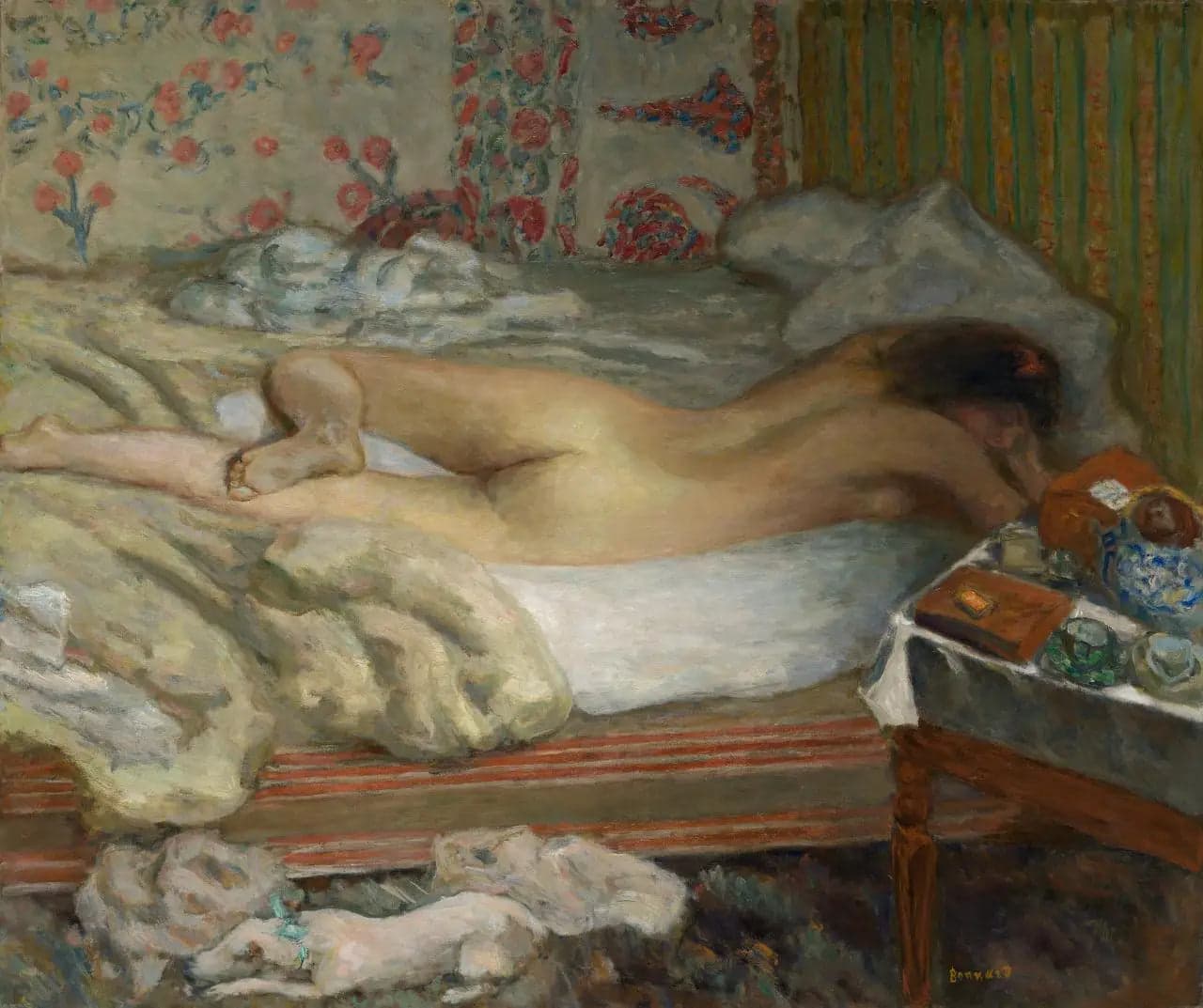
Nap
- Original dimensions
- 132 x 109 cm
- Museum
- National Museum of Victoria
- Year
- 1900
Scene depicted
In the painting “Sieste,” Pierre Bonnard immerses us in a world of fragility and rest. The intimate scene depicts a woman peacefully asleep, in a space bathed in soft light. The crumpled sheets and subdued light reveal an atmosphere of serenity, inviting the viewer to experience a sense of warmth and comfort. The composition, both simple and refined, conveys a fleeting beauty, like a bubble of daydream.
Historical context
Created in 1900, this canvas is set in the heart of Paris, the cradle of artistic movements of the late 19th century. Pierre Bonnard , a major figure of post-impressionism , captures here an intimate and warm atmosphere, typical of his time. Today, the painting is preserved at the National Museum of Victoria , a sanctuary of art, where it continues to enchant thousands of visitors.
Place in the artist's career
Sieste is situated at a decisive turning point in Pierre Bonnard 's career, illustrating his transition to a more personal and intimate approach to art. This masterpiece highlights his mastery of textures and lights, akin to his previous works such as “La Terrasse à Vernon” and “Le Déjeuner.” In the background, one recognizes the evolution of his style, which has become more vibrant and emotional, exploring the nuances of everyday life.
Anecdote
“Painting is a means of expressing the inexpressible,” Bonnard is said to have remarked one morning, inspired by the golden light and dancing shadows of his studio. This quote resonates as one contemplates Sieste , where peace and tranquility are translated into soft colors and delicate forms, capturing a fleeting moment in time.