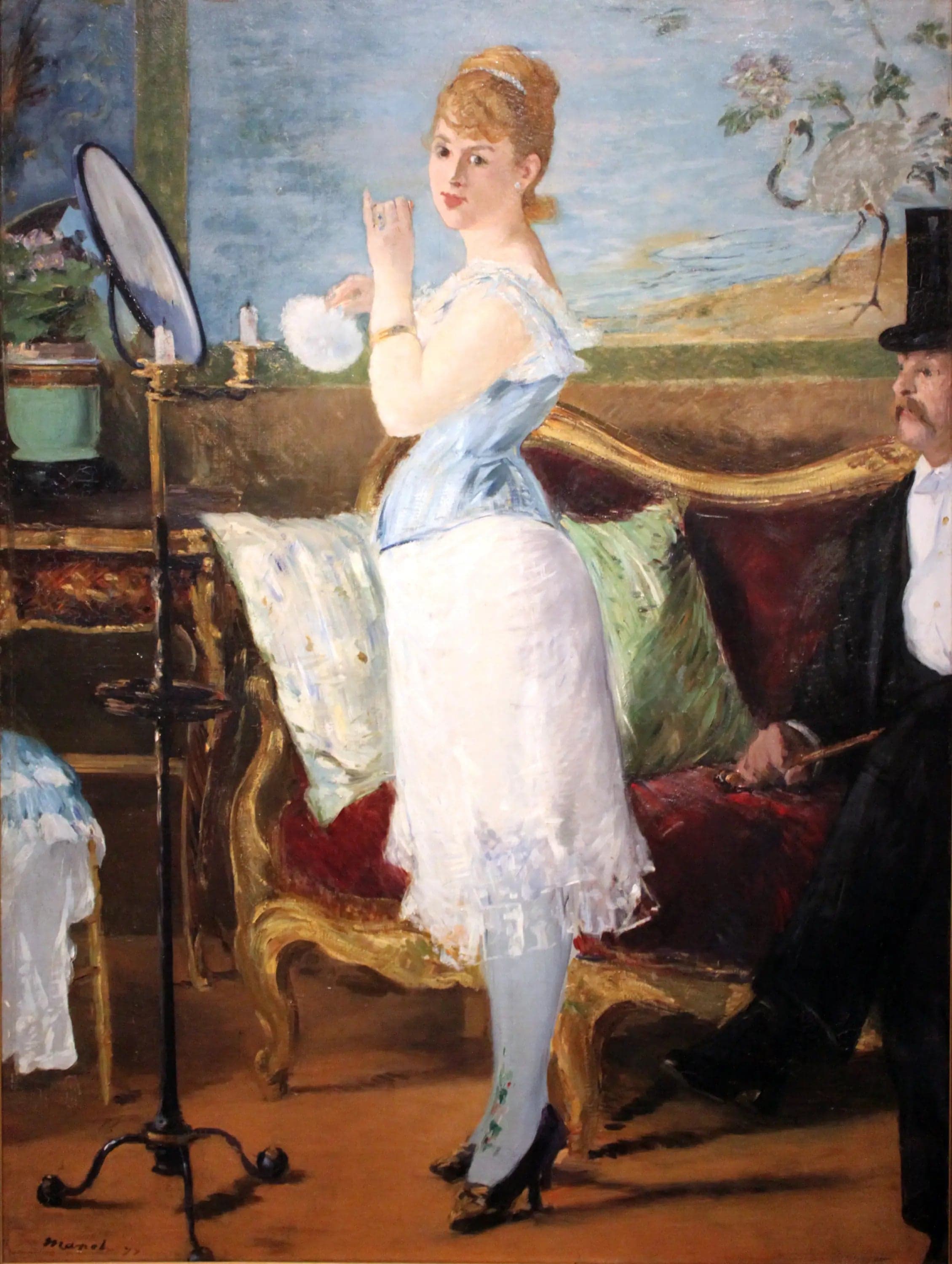
Nana
- Original dimensions
- 115 x 154 cm
- Museum
- Kunsthalle Hamburg
- Year
- 1877
Scene depicted
The painting “Nana” illustrates a woman of troubling beauty, depicted against the backdrop of a Parisian theater. With her enchanting gaze and suggestive posture, she embodies liberated femininity, oscillating between innocence and provocation. Manet, as a master of realism , captures here a moment of life, a fraction of a second where passion and desire intertwine.
Historical context
Created in 1877 in Paris, the painting emblematic of Manet is part of the Impressionist movement, marking a time of artistic and cultural renewal. This canvas , currently housed at the Kunsthalle Hamburg , embodies the vibrancy of Belle Époque Paris, where artists burst with creativity and boldness.
Place in the artist's career
This painting marks a turning point in Manet's career, illustrating a transition towards artistic maturity. Following “Olympia” and preceding “Luncheon on the Grass,” “Nana” reveals the evolution of his style, blending boldness and emotion with pictorial technique.
Anecdote
“Art is an adventure, a dance with light,” Manet liked to say. It was on a summer afternoon, strolling through the sunny streets of Paris, that he crossed paths with the captivating gaze of a courtesan. She became the muse for this pictorial work , where each brushstroke would capture the very essence of ephemeral beauty.