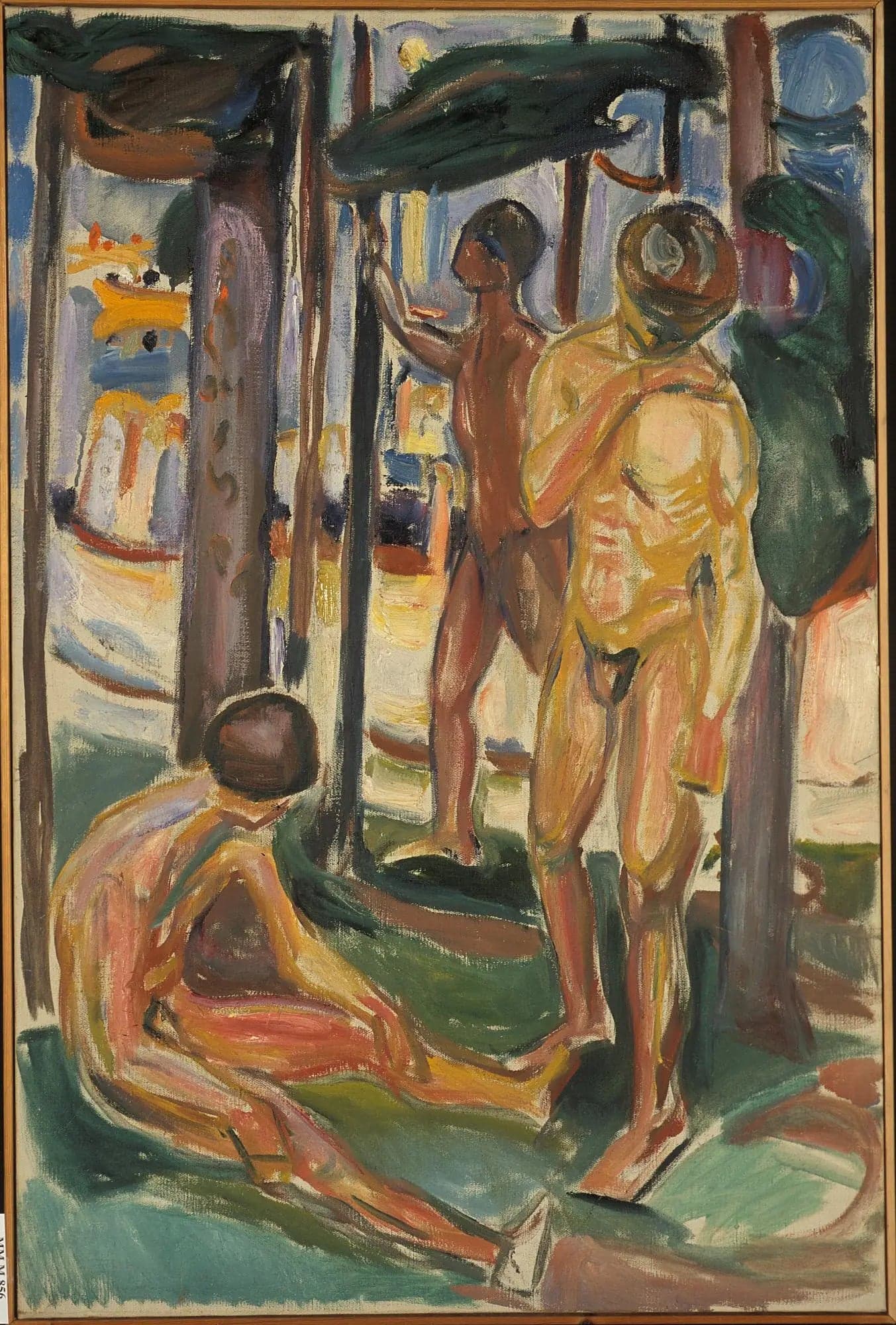
Naked Men in a Landscape
- Original dimensions
- 340.5 x 134 cm
- Museum
- Munch Museum
- Year
- 1900
Scene depicted
The canvas "Naked Men in a Landscape" is a bold and provocative representation of human beauty. Accompanied by nature, these male bodies, both vulnerable and powerful, seem to merge with the surrounding landscape. Munch reveals a dialogue between man and his environment, an exploration of nudity that transcends mere exposure to touch a universal aspect of our humanity. The composition conveys a palpable intimacy, where every shape, every contour, invites introspective reflection on the human condition.
Historical context
Created in 1900, this painting by Edvard Munch reflects a tumultuous era, caught between modern anxiety and the exploration of the human soul. Located in Oslo, this iconic work is part of the expressionist movement that redefined artistic conventions at the end of the 19th century. Today, the canvas , preserved in the Munch Museum, invites visitors to dive into a vibrant world of colors and emotions, with its majestic dimensions of 340.5 x 134 cm.
Place in the artist's career
This canvas marks a turning point in the career of Edvard Munch , illustrating his transition to a phase of artistic maturity. Following other canvases such as "The Madonna" and "The Scream," the work "Naked Men in a Landscape" represents a stylistic peak, where technique marries emotional depth. It is a crucial period for Munch, showcasing his growing mastery of human forms and their interactions with nature.
Anecdote
Edvard Munch once stated: "A canvas must sing, every brushstroke must carry an echo of the soul." This phrase resonates deeply when considering the genesis of his masterpiece , perhaps inspired by a misty morning when light makes its way through the trees, revealing the vulnerability of bodies. This fleeting moment under the glow of gentle spring light awakened his sensitivity and found refuge in Naked Men in a Landscape.