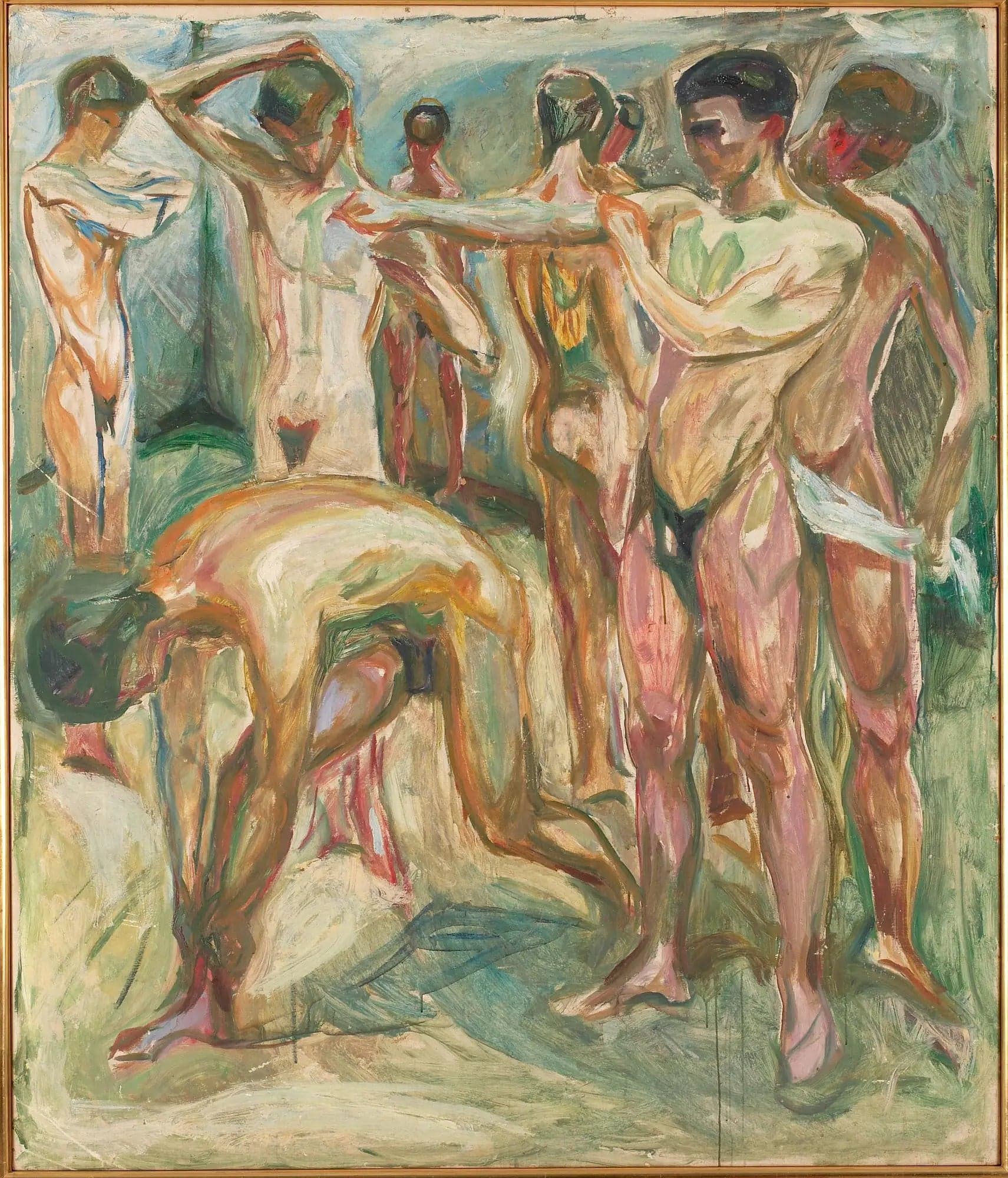
Naked Men at the Baths
- Original dimensions
- 128 x 150 cm
- Museum
- Munch Museum
- Year
- 1920
Scene depicted
The painting illustrates a scene of conviviality and acceptance of the body in a space of intimacy. The male figures, almost stripped of their clothing, focus on their own flourishing, thus engendering a sense of freedom and communion. The fluid lines and light effects contribute to this peaceful atmosphere, while the water, a mirror of souls, reinforces the message of devotion to the simple pleasures of life.
Historical context
Created in 1920, the painting "Naked Men at the Baths" is at the heart of the vibrant expressionist movement, which flourished in Oslo, Norway. This painting, currently housed in the Munch Museum, skillfully conveys the sociocultural concerns of its time: the quest for a new form of artistic expression in the face of contemporary upheavals. The work, with its imposing dimensions of 128 x 150 cm, captivates with its evocative power and immersive atmosphere.
Place in the artist's career
"Naked Men at the Baths" represents a crucial step in the career of Edvard Munch , where he moves away from earlier, darker works like "The Scream" to explore new territories of visual expression. In parallel, "The Madonna" and "The Dance of Life" demonstrate his evolution both technically and emotionally, revealing increasingly centered concerns on sensuality and humanity in its entirety.
Anecdote
Edvard Munch once stated: "Painting must be art, in harmony with nature." This credo resonates powerfully during the creation of his masterpiece . Inspired by a swim by a lake on a sunny morning, he challenged the bright light playing on the naked bodies. Thus, the canvas becomes a reflection of human intimacy in a natural setting, vibrant and charged with emotion.