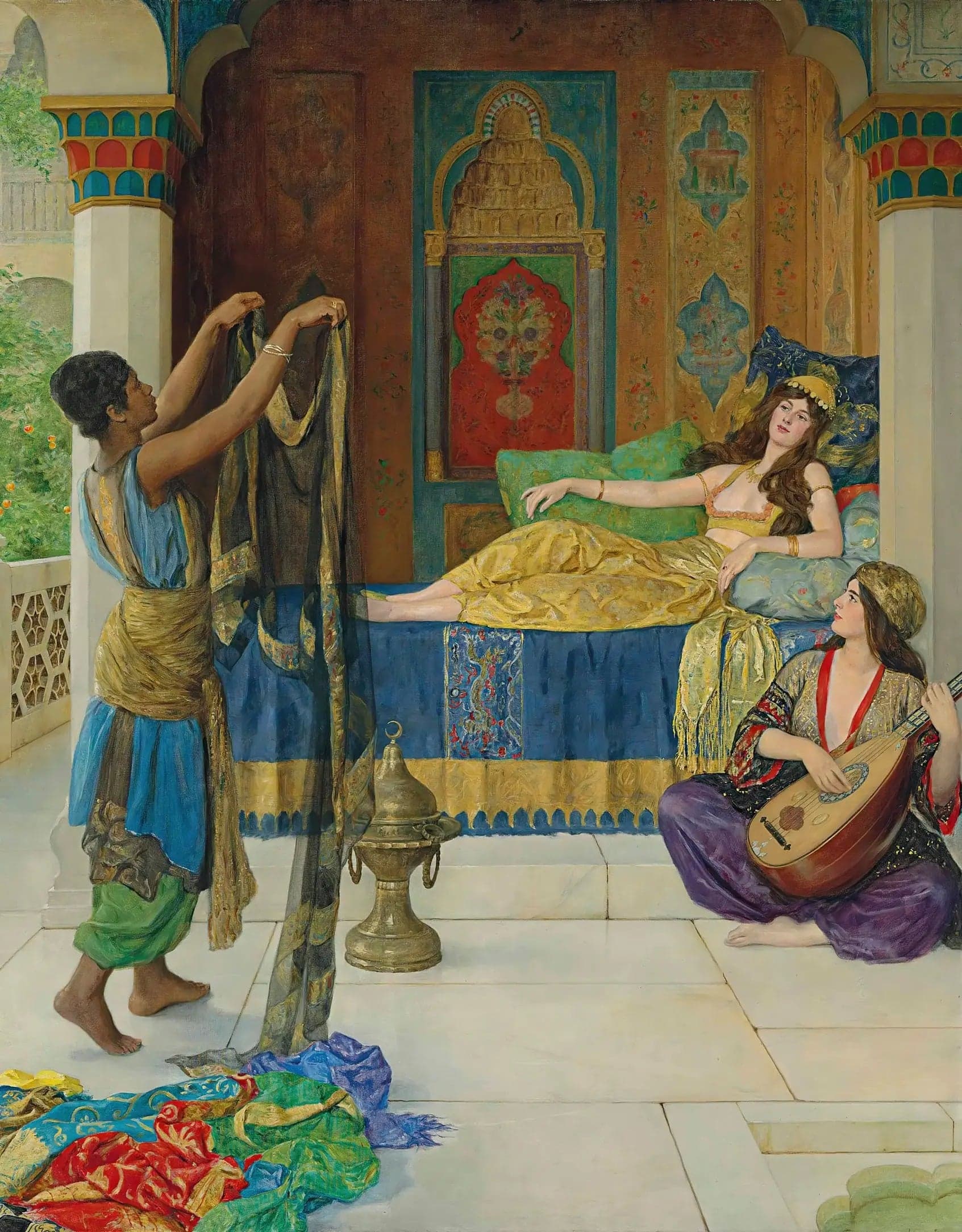
Myrrh, Aloe and Cassia
Scene depicted
In this painting , Collier transports us to a world where the senses are awakened. He invites us to contemplate a flourishing nature, symbolic of the treasures that the earth holds. At the heart of this pictorial work, the medicinal plants - myrrh, aloe, and cassia - stand majestically, sweeping our minds with a gentle tranquility.
Historical context
Created in 1906, the painting “Myrrh, Aloe and Cassia” finds its origin in the vibrant city of London, during the Pre-Raphaelite period. This artistic movement is characterized by a deep desire to return to nature, a poetic sensitivity, and a meticulous exploration of subjects. Currently, this tableau emblematic is part of a private collection, captivating gazes with its timeless beauty.
Place in the artist's career
“Myrrh, Aloe and Cassia” is part of a period of maturity for John Collier . After his initial works, where light and shadows danced on his tableaux , this painting marks a turning point, where his mastery of hues and textures is highlighted. Compared to “The Milkmaid” and “The Marriage of the Virgin”, we can detect a poignant evolution in his perception of nature and his commitment to beauty.
Anecdote
“Inspiration arises like a gentle breath in the morning, floating between the shadows of the foliage” could have said John Collier , evoking the genesis of his masterpiece . This is how one imagines the artist wandering in a lush garden, crossing whiffs of myrrh and aloe, capturing the very essence of this canvas .