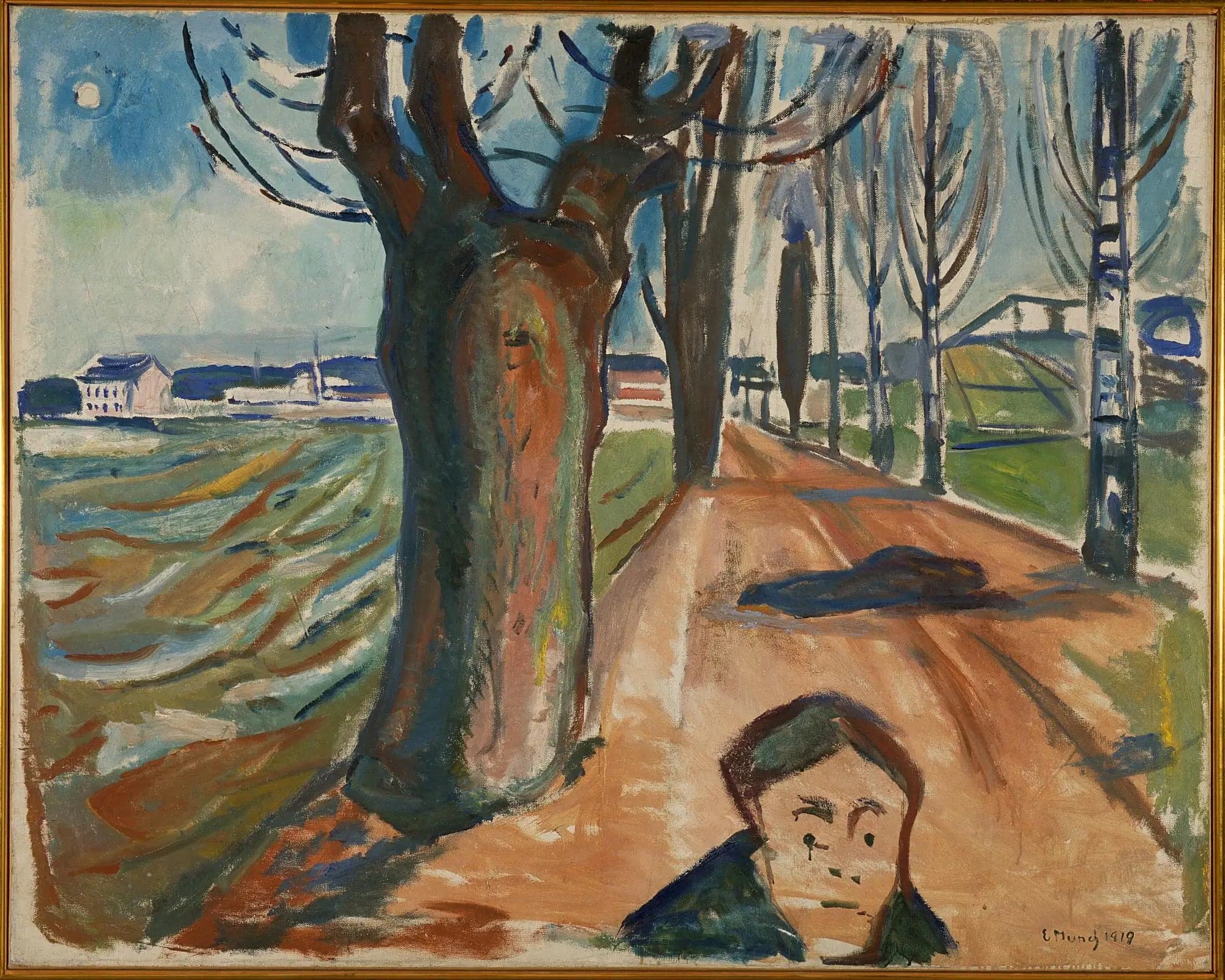
Murder on the Road
- Original dimensions
- 137.5 x 109.5 cm
- Museum
- Munch Museum
- Year
- 1919
Scene depicted
The painting “Murder on the Road” depicts a poignant and dramatic scene where the harsh light of car headlights clashes with the disturbed silence of the night. Munch captures not only the crime but also the heavy atmosphere surrounding it, that feeling of anxiety and darkness that permeates the painting, echoing a reality often considered taboo.
Historical context
Created in 1919, in the tranquil setting of Oslo, Norway, this painting is emblematic of the expressionist movement. Edvard Munch , as a pioneer of this era, brings an emotional and intense vision of the human condition, capturing poignant moments. The painting is now housed in the Munch Museum, a place dedicated to the legacy of this extraordinary artist, surrounded by works that resonate with the torments and passions of the soul.
Place in the artist's career
This painting , from a period of intense exploration for Munch, coincides with other masterpieces such as “The Madonna” and “The Scream.” With these compositions, he depicts an emotional evolution, moving from tragedy to a more intimate exploration of the human psyche, fully revealing the depth of his talent.
Anecdote
“Art must not only reproduce reality but transcend it,” said Munch, inspired by a dark night, as a tragic scene unfolded before his eyes. During a journey on a winding road, a feeling of unease had overwhelmed him, and he then sketched the idea for this canvas that transforms a murder into a reflection on human suffering.
Major exhibitions
Munch og Ekely: 1916-1944