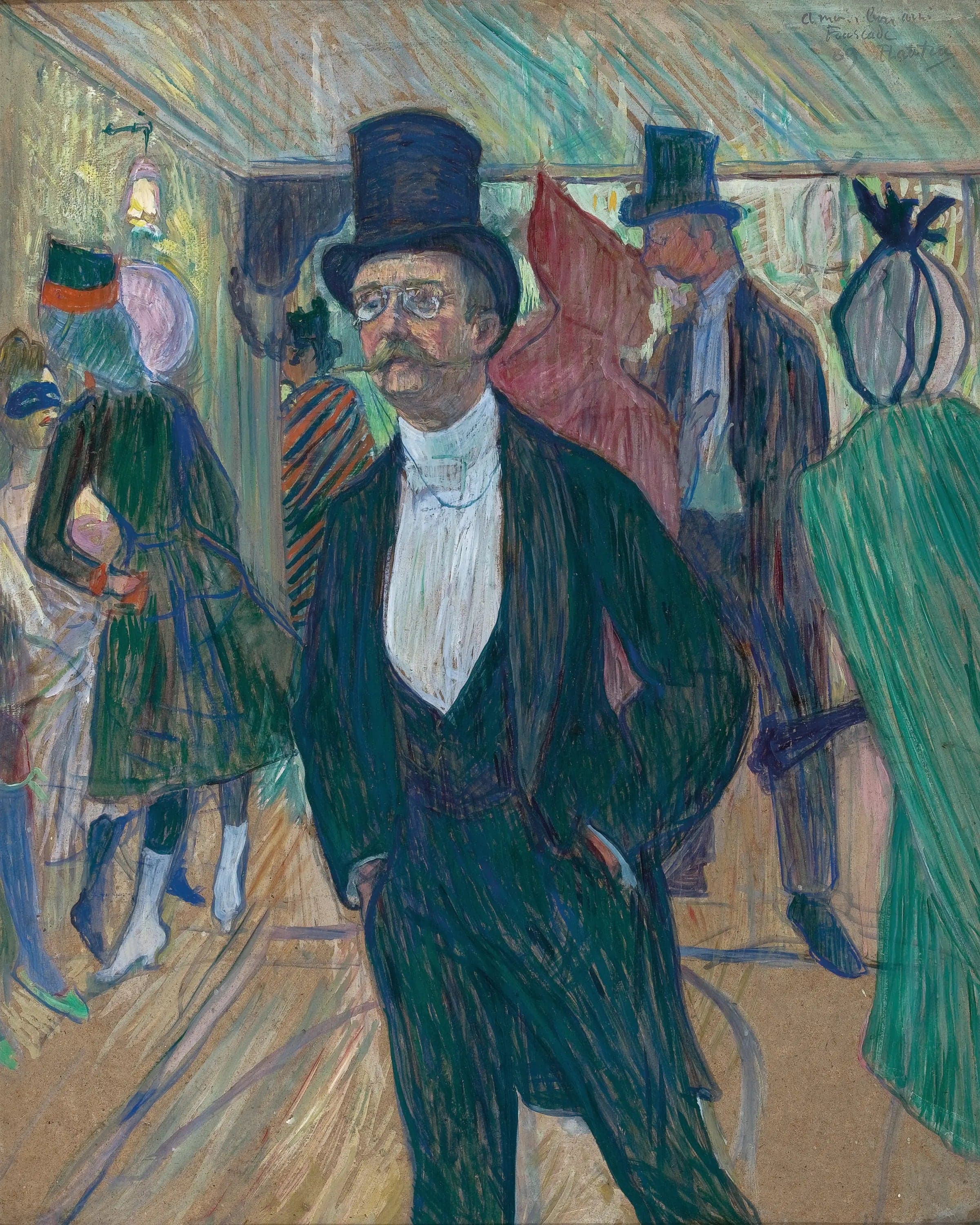
Mr. Fourcade - Henri de Toulouse
- Original dimensions
- 62 x 77 cm
- Museum
- São Paulo Art Museum
- Year
- 1889
Scene depicted
The painting "Monsieur Fourcade" features a man of character, captivating in his expression and demeanor. The composition, imbued with a uniqueness, captures the very essence of Parisians of the time, transcending the simple portrait to create a vibrant and lively pictorial work.
Historical context
Created in 1889, the painting "Monsieur Fourcade" is set in the artistic Paris of the late 19th century, a time marked by the Post-Impressionist movement. Toulouse-Lautrec, an emblematic figure of this movement, reveals a striking scene of daily life. The painting is currently displayed at the São Paulo Art Museum , enhancing the walls of this Brazilian metropolis with its brilliance.
Place in the artist's career
"Monsieur Fourcade" is situated at a decisive turning point in Toulouse-Lautrec's career. Evoking a period of maturity, it can be compared to other paintings such as "Dance at the Moulin Rouge" and "Women of Paris," two works that illustrate the evolution of his style and emotional approach to the subjects he chooses to represent.
Anecdote
“I paint what I see and I see what I feel.” These words, inspired by a moment of revelation on a spring morning, perfectly illustrate the birth of this masterpiece . It is in the lively streets of Montmartre that Toulouse-Lautrec meets Monsieur Fourcade, a character who embodies the soul of the Belle Époque, integrated into the evocative power of his painting .