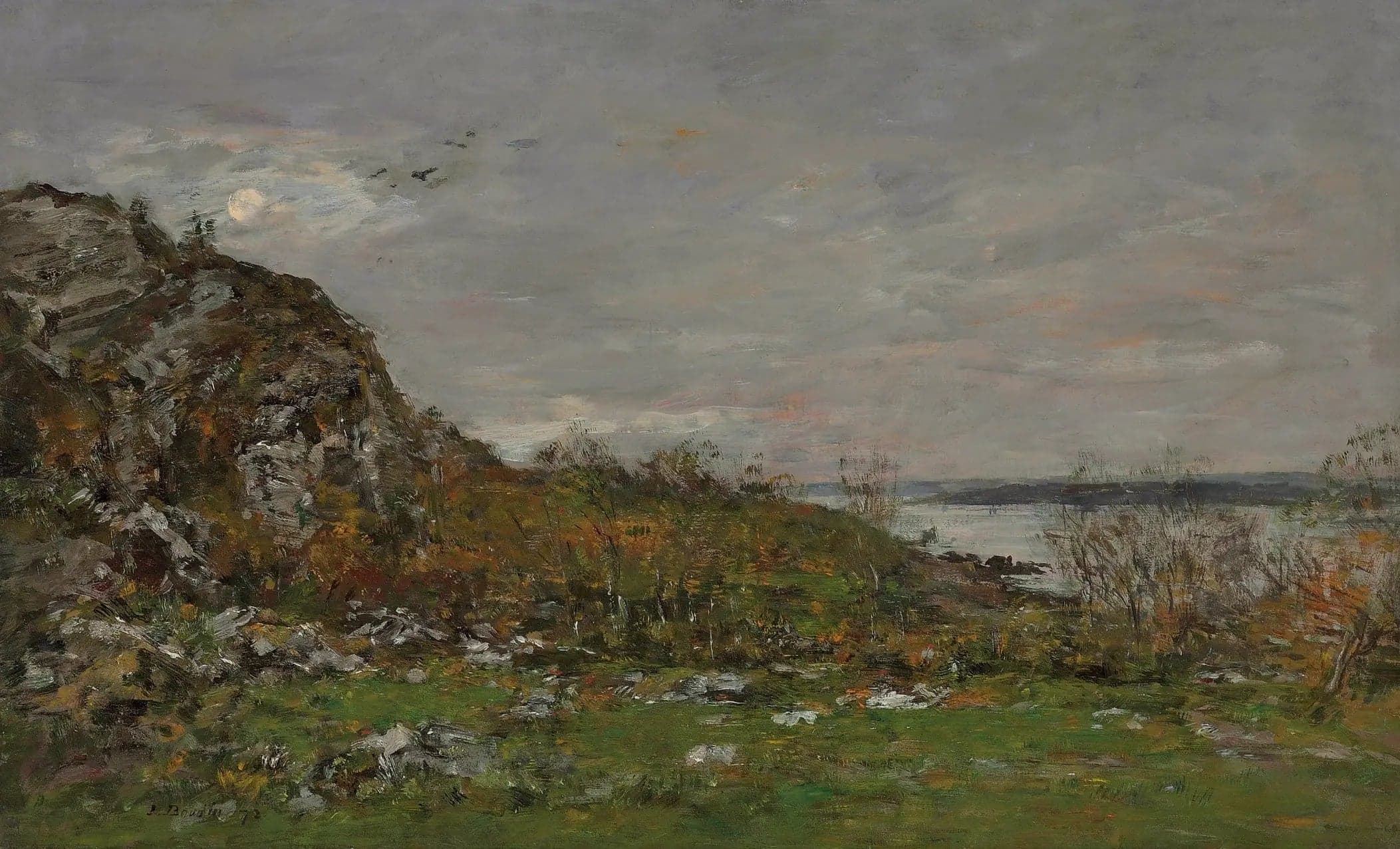
Mouth of the Elorn near Brest
- Original dimensions
- 89.5 x 54.6 cm
- Museum
- Not specified
- Year
- 1872
Scene depicted
In this painting , Boudin reveals to us a bucolic scene where the tranquility of the river marries the effervescence of the sea. The white sails of the boats unfurled in the wind contrast with the varieties of blues of the water, while the sky plays with shades that are sometimes pastel, sometimes vibrant. It is an invitation to daydream, to wander between land and sea.
Historical context
This painting is emblematic and was created in 1872, thus rooting itself in the impressionist movement that was gently emerging in the heart of the town of Brest, in Brittany. The canvas is not only an artistic representation but also a testament to the maritime importance of this region. It is today preserved in private collections, leaving the imagination to embellish it further.
Place in the artist's career
This canvas marks a pivotal period in Boudin's career. His earlier impressions, such as La Plage de Trouville and Les Bateaux à Honfleur , prepared him for this moment of artistic maturity. Mouth of the Elorn near Brest clearly illustrates his evolution towards a complete mastery of light and atmospheres, becoming one of the canvases that will further define him as a pioneer of impressionism .
Anecdote
“I have always believed that the sea has a soul, and it is this soul that I seek to capture.” Thus spoke Eugène Boudin , expressing his desire to translate the light and vibrant color within his pictorial works . It is with this passion that he conceived the masterpiece Mouth of the Elorn near Brest, a canvas born from coastal strolls in the early morning, when the mist brushes the sea, promising a bright day.