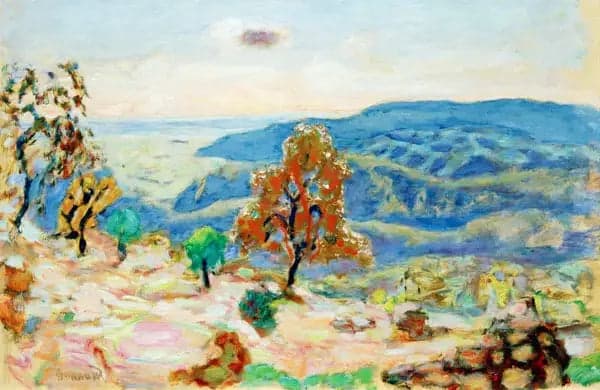
Mountain Landscape
- Original dimensions
- 68 x 46.5 cm
- Museum
- building of the Fine Arts Museum of Winterthur
- Year
- 1912
Scene depicted
In this painting, the composition evokes majestic mountains, wrapped in a light of palpable softness. The lush hills contrast with the pure blue of the sky, while flashes of light play on the peaks, reflecting a moment of serenity and harmony. This painting does not merely represent; it invites contemplation, urging one to dive into a world where nature expresses itself powerfully.
Historical context
Created in 1912, this painting emblematic of Pierre Bonnard captures not only a mountain landscape but also the essence of an era overflowing with creativity and emotion. Located in the beautiful city of Winterthur, Switzerland, it is part of the Post-Impressionism movement, a movement that advocates for individual expression through the properties of the canvas . Currently, this painting is preserved in the Fine Arts Museum, a tribute to its timeless presence.
Place in the artist's career
This Mountain Landscape represents a pivotal moment in Bonnard's career. At the crossroads between his promising beginnings and his golden age, this painting illustrates his stylistic evolution. Alongside The Terrace at Vernonnet and The Water Lilies , one can clearly see the artist's progression towards a language of bold colors and a personal interpretation of the landscape.
Anecdote
“Light is nothing without shadow, and the landscape speaks more when it whispers.” It is with this thought that Bonnard sketched his inspiration for this masterpiece , one clear morning, where the gentle spring breeze caressed the snow-capped peaks. Each brushstroke in this painting translates the resonance of nature, a vibrant echo of his soul.