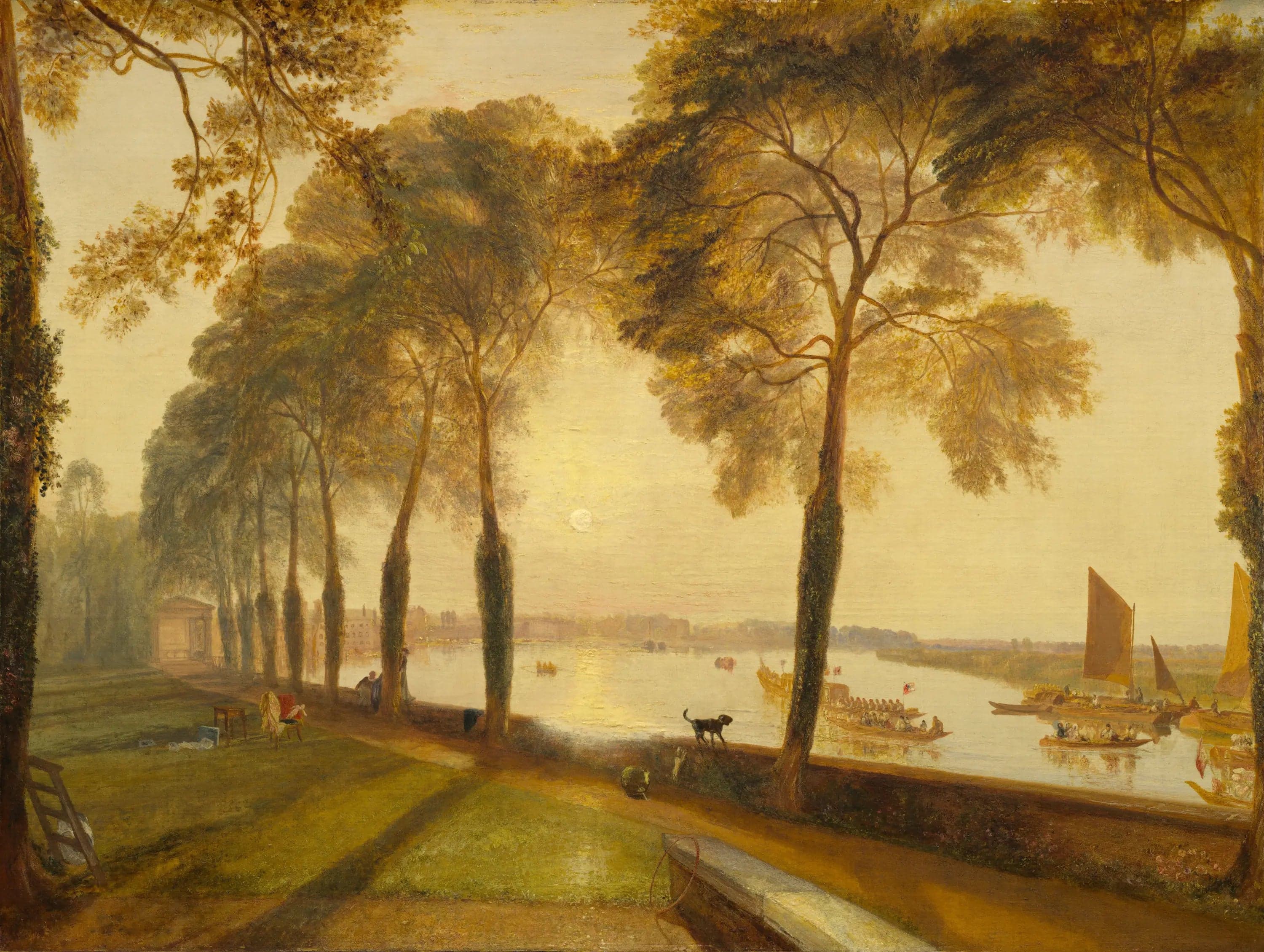
Mortlake Terrace
- Original dimensions
- 122.2 x 92.1 cm
- Museum
- National Gallery of Art
- Year
- 1827
Scene depicted
'Mortlake Terrace' presents a bucolic landscape, a peaceful scene where nature and man coexist harmoniously. Houses of typically English charm flow along the Thames, while the light plays on the water, creating a wave effect that seems to breathe. This painting evokes a tranquil life, a passage of time, capturing a nostalgic atmosphere characteristic of the romantic era.
Historical context
Created in 1827, the painting "Mortlake Terrace" by Joseph Mallord William Turner is set in a historical context where England is transforming, a country vibrant with innovations and artistic expressions. Located in the city of London, this pictorial work belongs to the romantic movement, famous for its ability to capture the essence and power of nature. Currently exhibited at the National Gallery of Art , every dimension of this canvas reflects a part of emotion and light.
Place in the artist's career
This painting marks a key period in Turner's career, where the artist reaches a striking stylistic maturity. Compared to works such as 'The Fighting Temeraire' and 'Rain, Steam and Speed', 'Mortlake Terrace' shows an evolution in the use of light and colors, a testament to an increased mastery of atmospheric effects.
Anecdote
Joseph Mallord William Turner , known for his passion for light, is said to have remarked: "Nature is a living painting, and every moment is a new composition to paint." That morning, by the Thames, the artist observed the gentle murmur of the waters interlaced with the golden light of the rising sun, a moment that inspired him to create this masterpiece , a painting with raw and captivating emotion.