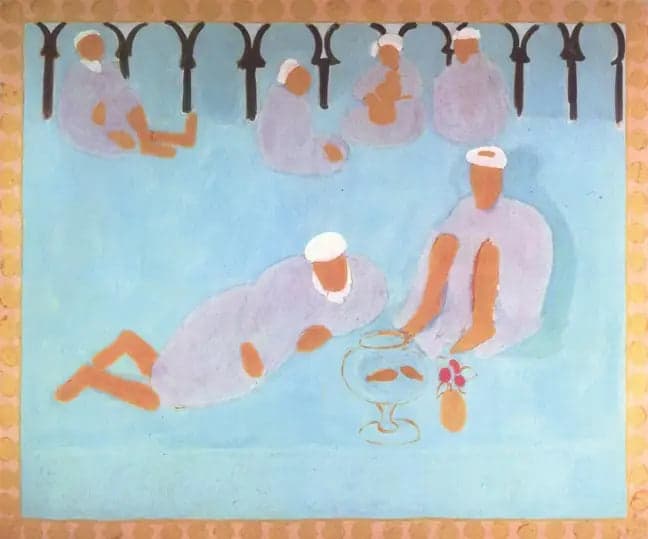
Moroccan Café
- Original dimensions
- 210 x 176 cm
- Museum
- Hermitage Museum
- Year
- 1913
Scene depicted
In Moroccan Café , Matisse captures a vibrant scene of life, inviting the viewer to immerse themselves in the warm atmosphere of a lively café. Colorful characters overflow with dynamism, while a richly set table underscores the importance of human interactions. Every detail reveals a world in full swing, like a moment frozen forever in the flow of time, creating a palpable atmosphere that awakens the senses.
Historical context
Created in 1913, in the vibrant city of Tangier, this painting is emblematic of the Fauvist movement, led by Matisse. Tangier, an oasis of exoticism and light, undoubtedly influences the vibrant palette of this canvas . Currently, the painting resides in the famous Hermitage Museum , where it continues to amaze art lovers. Its imposing dimensions of 210 x 176 cm make this pictorial work a true masterpiece in the space it occupies.
Place in the artist's career
Moroccan Café represents a turning point in Matisse's career. This painting falls within a period where he explores new dimensions of expressionism, in contrast to his previous work like The Joy of Life . Alongside The Dance , these creations reveal an evolution towards bold abstraction, while preserving the warmth and human emotion characteristic of his unique style.
Anecdote
“Color must serve light and emotion.” These words resonate strongly when observing the moment inspiration strikes for this painting . Imagine Matisse, one bright morning in Tangier, absorbing the spicy aromas of cafés, listening to the murmur of conversations, and contemplating the reflections of golden light on sunlit walls. This painting is the result of an intimate dialogue with the living nature of the city.