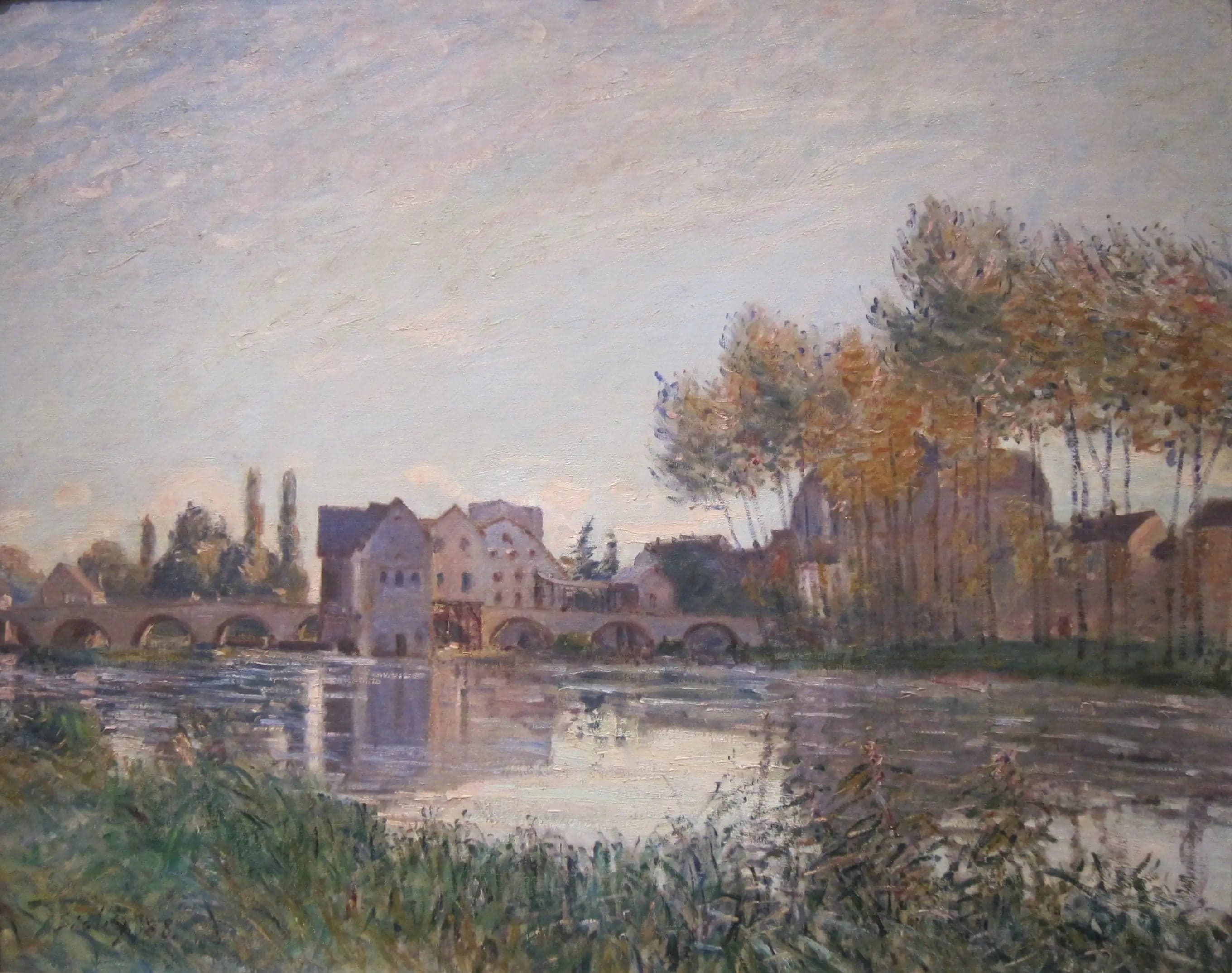
Moret at Sunset
- Original dimensions
- 92.1 x 73.7 cm
- Museum
- Cincinnati Art Museum
- Year
- 1888
Scene depicted
The painting “Moret at Sunset” depicts a vibrant sky with golden hues, while the Loing River reflects under these poetic lights. The silhouettes of the trees frame this scene, creating a delicate dialogue between nature and the human soul, awakening memories and emotions.
Historical context
Created at the end of the 19th century, this painting immerses the viewer in the picturesque charm of Moret-sur-Loing, a small town nestled in the heart of the Île-de-France region. Alfred Sisley , a major figure of the Impressionist movement, illustrates here the harmony between light and nature, a signature of his style. The canvas is currently on display at the Cincinnati Art Museum , where it continues to amaze visitors.
Place in the artist's career
This painting marks a pivotal moment in Alfred Sisley's career, where his mastery of light reaches its peak. Alongside other paintings such as Monet's “Impression, Sunrise” and Sisley's “The Bridge at Moret,” one observes an evolution of Expressionism Impressionism and the quest for poetic truth in nature.
Anecdote
“I have always found a deep tranquility in the light dancing on the water of rivers,” Sisley might have said one morning while watching the sun set over Moret. It is in this idyllic setting that inspiration burst forth, making this canvas a window into a forgotten serenity.