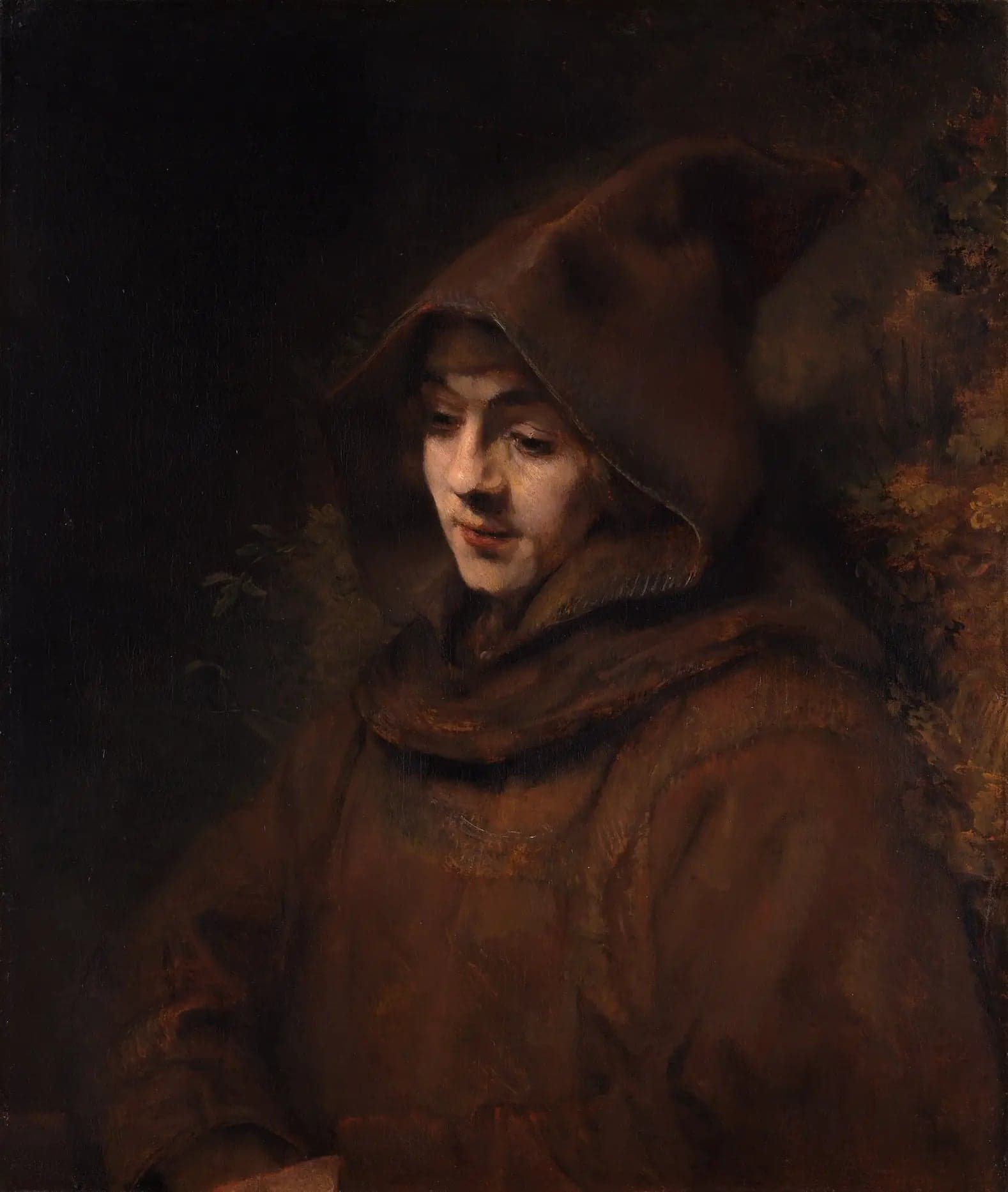
Monk Titus
- Original dimensions
- 67.7 x 79.5 cm
- Movement
- Dutch Golden Age painting
- Museum
- Rijksmuseum
- Year
- 1660
Scene depicted
In this poignant composition, we discover Titus, draped in a monastic robe, representing the inner dilemma between earthly and spiritual life. With his head bowed, he seems to reflect on the meaning of his existence, making this painting both personal and universal.
Historical context
Created in 1660, this painting emblematic plunges us into a vibrant Amsterdam, at the heart of the Dutch Golden Age of painting. This painting, currently exhibited at the prestigious Rijksmuseum , bears witness to a time when art illuminated minds, giving rise to indescribable emotions. With dimensions of 67.7 x 79.5 cm, every detail of this canvas captivates the eye.
Place in the artist's career
Titus en moine is situated at a pivotal moment in Rembrandt 's career, illustrating his mature style. This painting could be paralleled with works like “The Night Watch,” where the play of light is mastered, and “The Anatomy Lesson of Dr. Tulp,” demonstrating his ability to marry technical performance with poignant emotion.
Anecdote
“Art does not imitate nature, it celebrates it,” said Rembrandt . One can imagine that one spring morning, as golden light flooded his studio, he found his inspiration in a glance exchanged with his son, the soul of the work soon to be cinematic taking shape under his fingers. This evocative force is palpable in Titus en moine , a canvas that speaks of filial love and human depth.