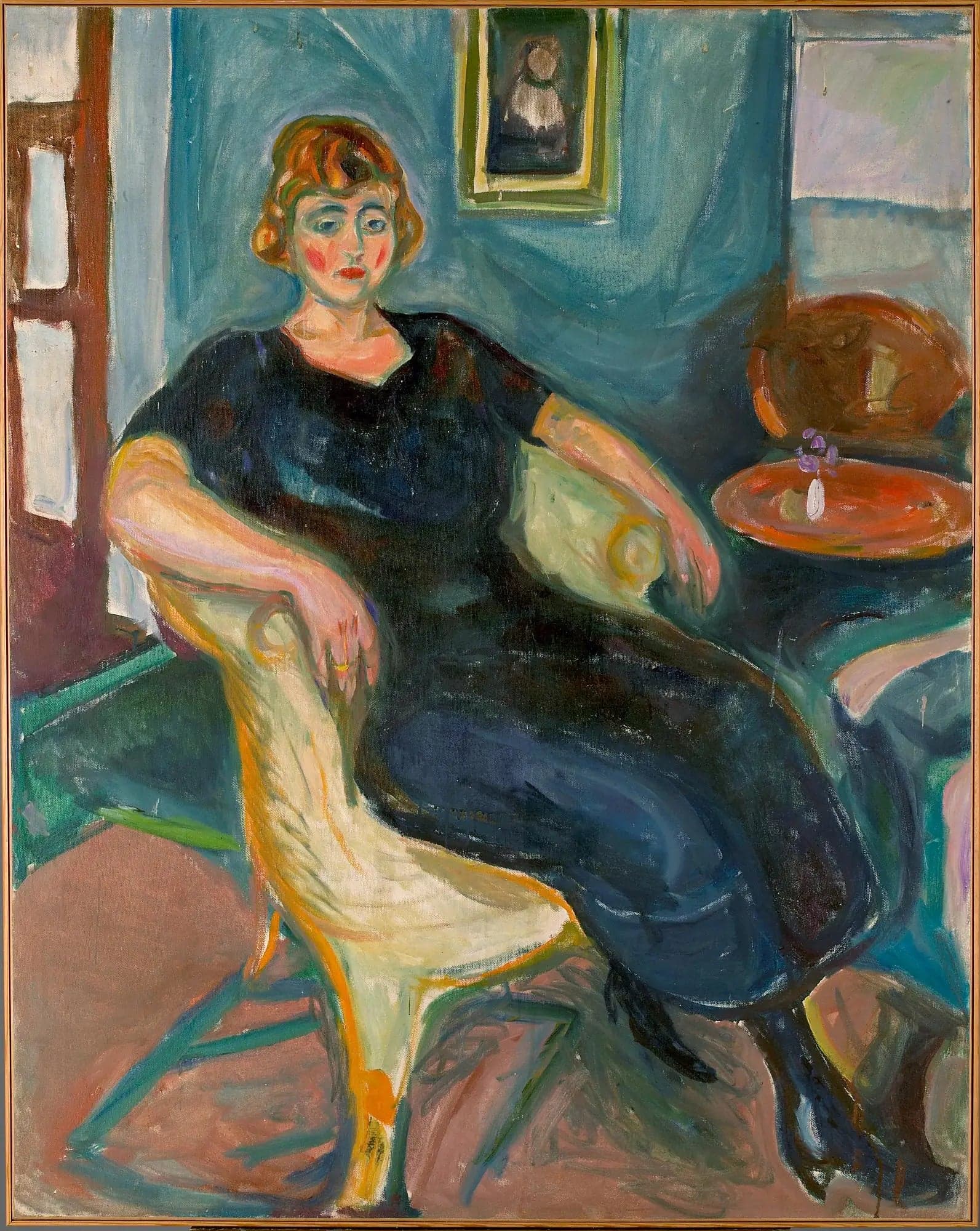
Model in a wicker chair
- Original dimensions
- 100.5 x 72 cm
- Museum
- Not specified
- Year
- 1924
Scene depicted
In this captivating composition, the model appears immersed in deep introspection, accompanied only by the organic shapes of her wicker chair. Munch, through his unique style, invites us to explore a scene of solitude, shadow and light playing on the features of the face. The background evokes a tranquil intimacy, where every detail contributes to generating a feeling of melancholic calm.
Historical context
Painted in 1924, this canvas is emblematic of the atmosphere of a changing Europe, at the heart of the expressionist movement of which Munch was one of the pioneers. It is a pictorial work created in a rich artistic context, as Munch explores human emotions with poignant intensity. This painting is not just a picture, it is an exploration of feelings, a testimony. To this day, its exact location remains to be defined, but its essence is undeniably alive in every brushstroke.
Place in the artist's career
Model in a Wicker Chair fits into a pivotal period of Munch's career, marked by a thorough exploration of anxiety and human relationships. This painting can be compared to The Scream and The Madonna , where the artist develops his emotional technique while perfecting his style. Over time, his works become deeper and more personal reflections, thus revealing the complexity of his artistic genius.
Anecdote
“I seek to reveal the heart of the human soul, even in the banality of everyday life.” perhaps Munch declared one sunny morning, as he observed a model, lost in thought. This quote summarizes well the man behind the masterpiece . In the pale light of spring, an inspiration bursts forth, illustrating the depth highlighted in Model in a Wicker Chair .
Major exhibitions
Edvard Munch and his models: 1912-1943