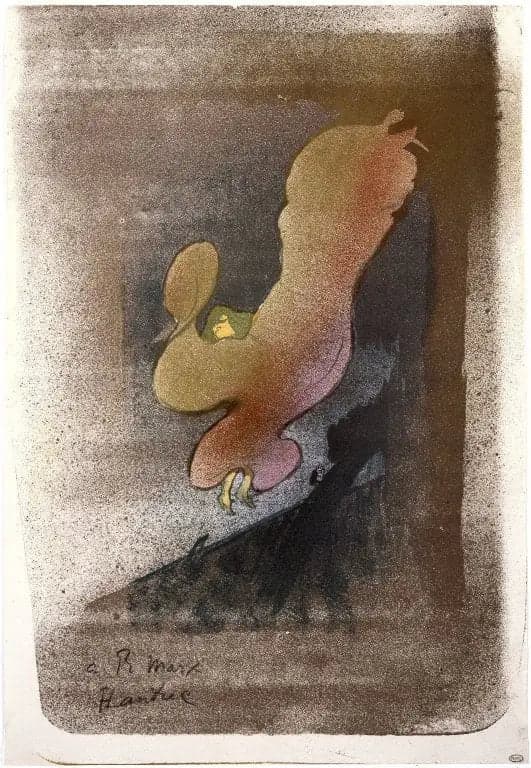
Miss Loïe Fuller - Henri de Toulouse
- Original dimensions
- 26.6 x 37 cm
- Museum
- Brooklyn Museum
- Year
- 1893
Scene depicted
The painting features Loïe Fuller, an icon of dance, illuminating the stage with her enchanting movements, where the drapes of her costumes blend with the play of light. She perfectly embodies the free and creative spirit of her time, captivating the audience with her mesmerizing grace. This composition is a testament to the famous "Serpentine Dance," a true ode to the art of movement.
Historical context
Created in 1893, the painting “Mademoiselle Loïe Fuller” emerges in Paris, the vibrant epicenter of the Belle Époque. Under the influence of Art Nouveau, this canvas illustrates a period marked by the emancipation of women and the rise of the arts. Currently housed at the Brooklyn Museum , this work by Henri de Toulouse-Lautrec measures 26.6 x 37 cm, reflecting its elegant format conducive to contemplation.
Place in the artist's career
“Mademoiselle Loïe Fuller” represents a milestone in Toulouse-Lautrec's career. At this time, he is at his stylistic peak, merging sketch and color. In contrast to other paintings like “At the Moulin Rouge” and “The Toilette,” this masterpiece evokes artistic maturity, beautifully combining emotion and technique.
Anecdote
“Dance is a story of the soul, a silent cry,” said Toulouse-Lautrec. One spring morning, as the first lights of dawn caressed Paris, he discovered Loïe dancing, like an apparition. This moment of inspiration is at the source of the evocative power of this canvas , vibrant with life and emotions.