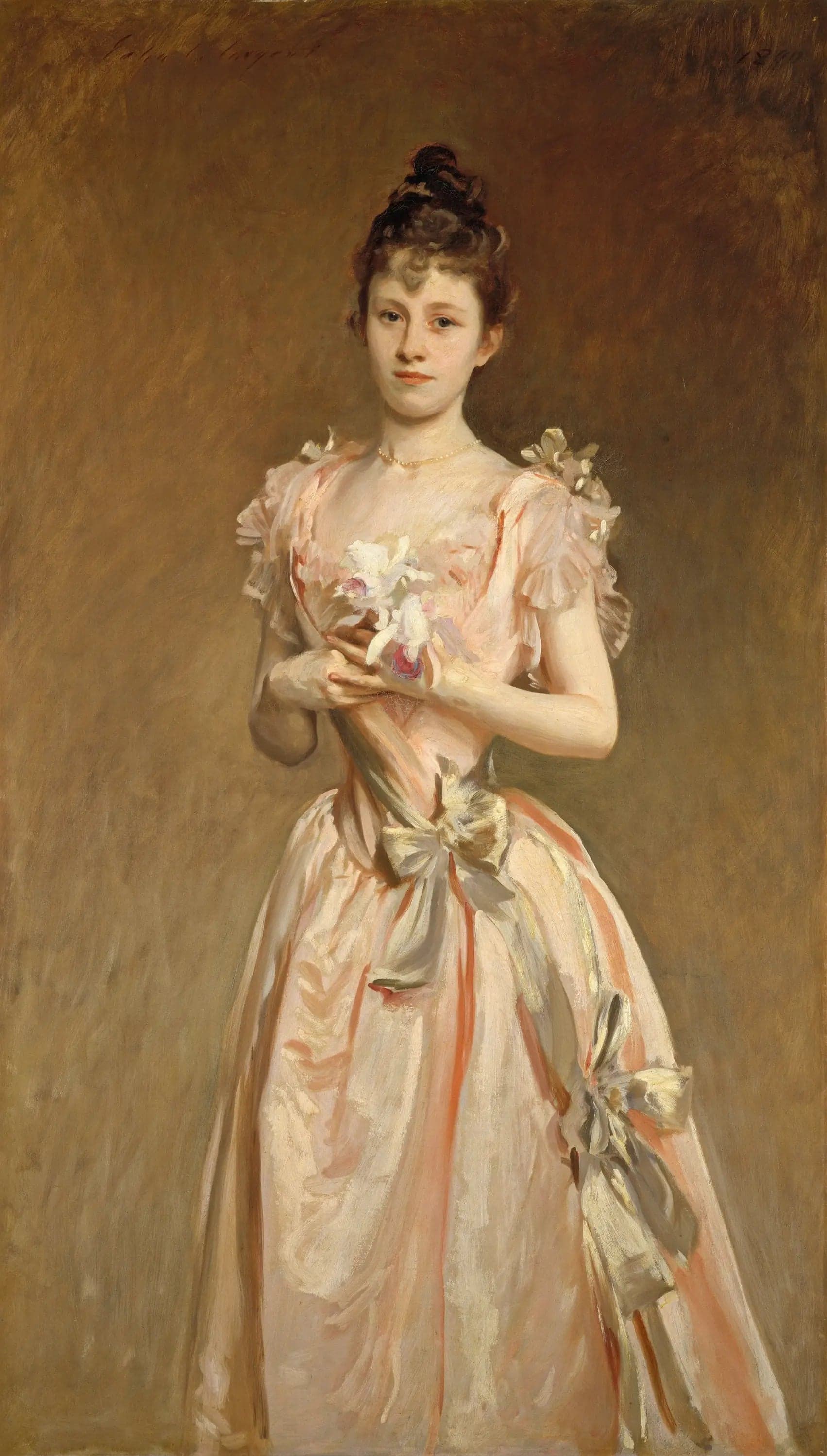
Miss Grace Woodhouse
- Original dimensions
- 94 x 162.9 cm
- Museum
- National Gallery of Art
- Year
- 1890
Scene depicted
This painting illustrates a young woman of high society, still and pensive, free from any virtuality, immersed in an intimate world. The grace that emanates from her gaze and posture evokes feelings of contemplation and serenity, expected in a burgeoning bourgeois setting. The painting depicts not only a portrait but a story, that of an era where every gesture was imbued with nobility and sophistication.
Historical context
Created in 1890, this painting emanates from the brilliant mind of John Singer Sargent , at a time when the Impressionists are reaching their peak. Located in Washington, in the prestigious National Gallery of Art , this canvas is at the heart of a fascinating artistic movement, between realism and innovation. In a context where Victorian society is transforming, the masterpiece captures the very essence of this period, oscillating between tradition and modernity.
Place in the artist's career
“Miss Grace Woodhouse” marked one of the turning points in Sargent's career, illustrating his impressive mastery in portraiture. This masterpiece majestically fits into a lineage of other glorious portraits such as “Madame X” and “Carnation, Lily, Lily, Rose,” testifying to a remarkable stylistic evolution while anchoring his work in the high society of his time.
Anecdote
“Beauty is a promise of happiness,” said Sargent, inspired by the captivating faces he encountered. It was during a gentle summer morning that he crossed paths with Grace, a moment suspended in time, illuminated by the soft light filtering through the windows of an elegant parlor. This canvas serves as a mirror of this encounter, revealing an unparalleled emotional depth.