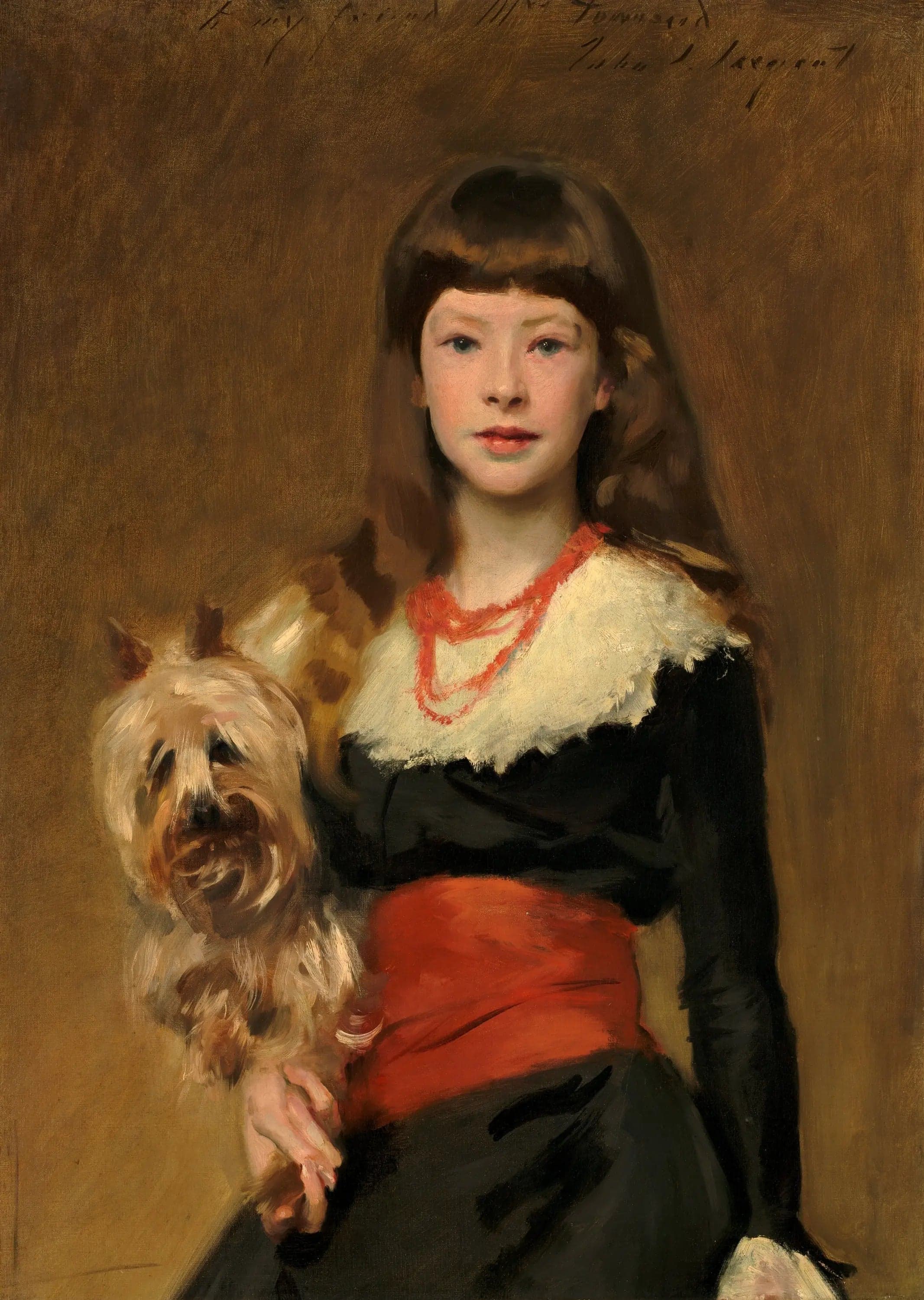
Miss Béatrice Townsend
- Original dimensions
- 58.4 x 79.4 cm
- Museum
- National Gallery of Art
- Year
- 1882
Scene depicted
The masterful composition of Mademoiselle Béatrice Townsend highlights the portrait of a young woman posing with unmatched grace. Wrapped in an elegant dress, she stands with a confidence that exudes both a lightness of spirit and a quiet strength. In this burst of color and light, Sargent captures not only the physical appearance but also the spirit of the protagonist, making the painting vibrant and timeless.
Historical context
Created in 1882, the painting Mademoiselle Béatrice Townsend is part of the movement of realism and portraiture at the end of the 19th century, at a time when Europe is experiencing notable artistic upheavals. Currently displayed at the National Gallery of Art in Washington, this magnificent canvas evokes the bourgeois milieu of its time, finely capturing the essence of an era when the art of portraiture becomes a true cultural and historical testimony.
Place in the artist's career
This painting is part of the mature period of John Singer Sargent , representing a peak of his distinctive style. Alongside works such as Madame X and The Daughters of Edward Darley Boit , Mademoiselle Béatrice Townsend illustrates the artist's evolution towards technical and emotional mastery, while also reflecting the Parisian influences that surrounded him.
Anecdote
“Beauty lies in the eye of the beholder,” Sargent might have said, inspired by the soft light of a spring morning, as he met Béatrice Townsend. This fleeting moment, transposed onto the canvas, reveals the emotional depth and expressiveness of his portrait, where each brushstroke seems to whisper the story of a face, a soul.