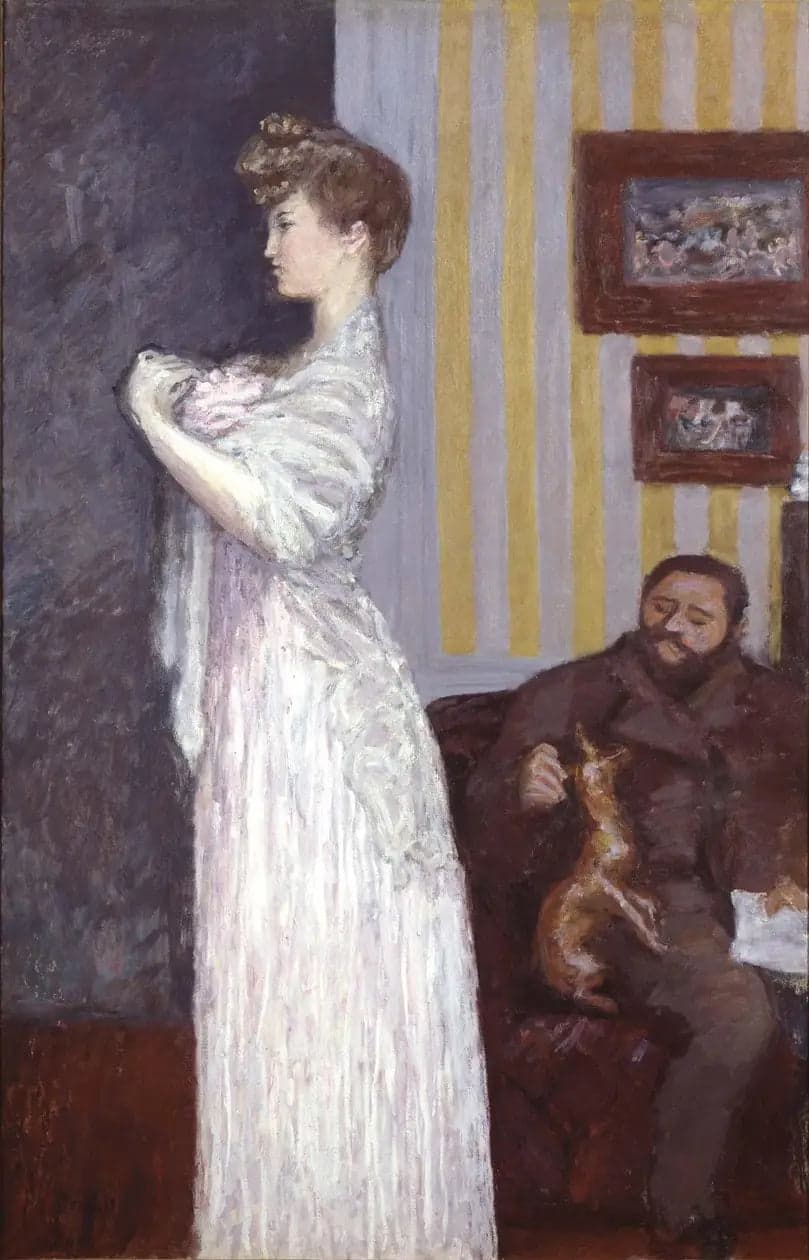
Misia Godebska and Thadée Natanson
- Original dimensions
- 86.5 x 133 cm
- Museum
- Royal Museums of Fine Arts of Belgium
- Year
- 1902
Scene depicted
The scene captured in the painting delicately represents a moment of intimacy between Misia Godebska and Thadée Natanson. Their tender faces, illuminated by a soft and warm light, tell the story of a deep and sincere love. The colorful garments vibrate under the brush, each detail evoking the sweetness of the Belle Époque, a time when life was fully lived and art reigned.
Historical context
Created in 1902 in Paris, at the heart of the Belle Époque, the painting "Misia Godebska and Thadée Natanson" belongs to the intimate movement of Fauvism , a movement marking the love of vibrant colors. In this prosperous era, where artists, writers, and intellectuals mingled, this canvas stands as a symbol of a flourishing time. Today, this work is carefully preserved in the Royal Museums of Fine Arts of Belgium , where its immense dimensions of 86.5 x 133 cm captivate all visitors.
Place in the artist's career
"Misia Godebska and Thadée Natanson" marks a turning point in the career of Pierre Bonnard , elevating him to the ranks of the masters of Fauvism . This painting reflects a period when his colors begin to vibrate with intensity. Unlike his previous work, "The Terrace at Vernon," his bold use of light in this canvas testifies to a marked technical evolution. At the same time, just like "The Red Tablecloth," he succeeds in capturing the intimacy of everyday life while enhancing human relationships.
Anecdote
"Beauty lies in the eye of the beholder," said Bonnard as he observed the gentle face of Misia, his muse and accomplice. That morning, bathed in the golden light of spring in Paris, he let colors escape that should never have been captured, but which cried out to the world the love of art and life. The masterpiece he created thus became a |>canvas| where the subject, light, and emotion intertwine.