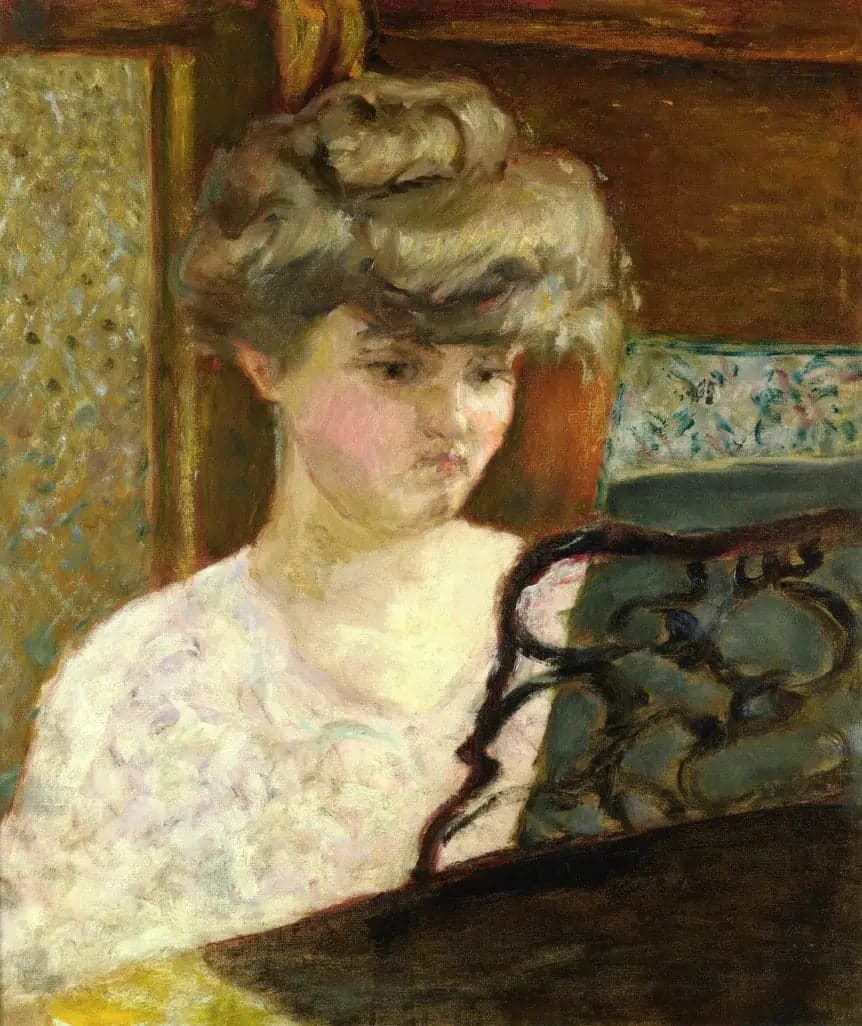
Misia at the Piano
- Original dimensions
- 39.1 x 46.1 cm
- Museum
- Not specified
- Year
- 1902
Scene depicted
In "Misia at the Piano," Pierre Bonnard depicts an intimate scene where his muse, Misia Sert, immerses herself in music. Misia's gentle and absorbed gaze, lost in her melodic thoughts, invites the viewer to feel the peaceful and melodious atmosphere of the salon. The nuances of colors, bright and warm, transform the canvas into a true visual symphony, full of softness and depth.
Historical context
Created in 1902, at the crossroads of Impressionism and Post-Impressionism , the painting "Misia at the Piano" by Pierre Bonnard is set in the artistic Saint-Germain-des-Prés, in Paris. This iconic painting is the result of a period of intense artistic flourishing, where bright colors and plays of light intertwine in a unique composition, inviting every gaze to dive into its muted atmosphere.
Place in the artist's career
Positioned at the heart of a thriving career, "Misia at the Piano" marks a significant turning point for Pierre Bonnard . At this time, the already recognized artist explores bolder techniques, as seen in "The Salon of the Rue de la France" and "The Terrace at Vernon." These works testify to his relentless search for light and emotion, establishing Bonnard as a master of delicate and poetic atmospheres.
Anecdote
“Light has its own rhythm, a dance that only the sensitive can hear,” Bonnard is said to have reflected on his masterpiece . Inspired one spring morning with languorous softness, the face of Misia, his muse, awakens vivid emotions, resonating in the melodious echo of piano notes floating around them. This painting then becomes an open window into their shared intimacy.