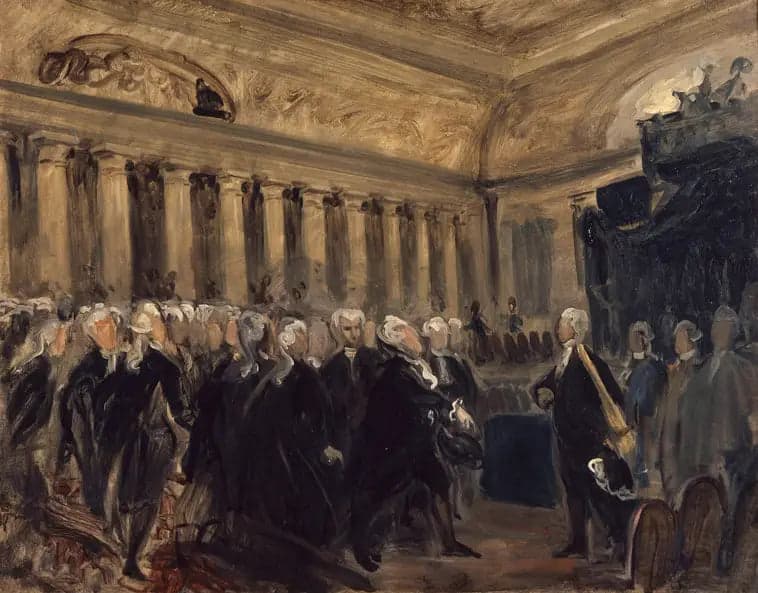
Mirabeau before Dreux-Brézé
- Original dimensions
- 82 x 68 cm
- Museum
- national museum Eugène-Delacroix
- Year
- 1831
Scene depicted
The painting Mirabeau before Dreux-Brézé illustrates a significant historical moment, capturing the eloquence of a man in the midst of a speech. Here, Mirabeau stands with strength and determination, his powerful gestures testifying to the sharpness of his convictions. The dramatic scene imposes itself, illuminated by a soft yet resolute light, while the characters around him attach importance to the message that emerges in the air.
Historical context
Created in 1831, the painting titled Mirabeau before Dreux-Brézé is at the heart of the romantic movement, which seeks to express human passions and the turmoil of the soul. Located in Paris, this work was born during a period marked by political and social upheaval, reflecting the aspirations of a nation in search of freedom. Today, this painting is exhibited at the national museum Eugène-Delacroix, testifying to the richness of French artistic heritage.
Place in the artist's career
This painting is a milestone in the career of Eugène Delacroix , marking his rise to the rank of romantic master. After works such as Liberty Leading the People and The Massacres of Scio , Mirabeau before Dreux-Brézé represents the maturation of his style, with his compositions becoming increasingly bold, both artistically and emotionally.
Anecdote
“Color is sensitivity itself; it must vibrate like a heart in turmoil.” This quote, although fictional, could come from the pen of Eugène Delacroix , evoking his passion for painting . Imagine a spring morning when the artist, inspired by the soft light and the palpable tension of political events, fervently sketches this masterpiece . Each brushstroke is a promise of life, a surge of emotion that crystallizes on the canvas .