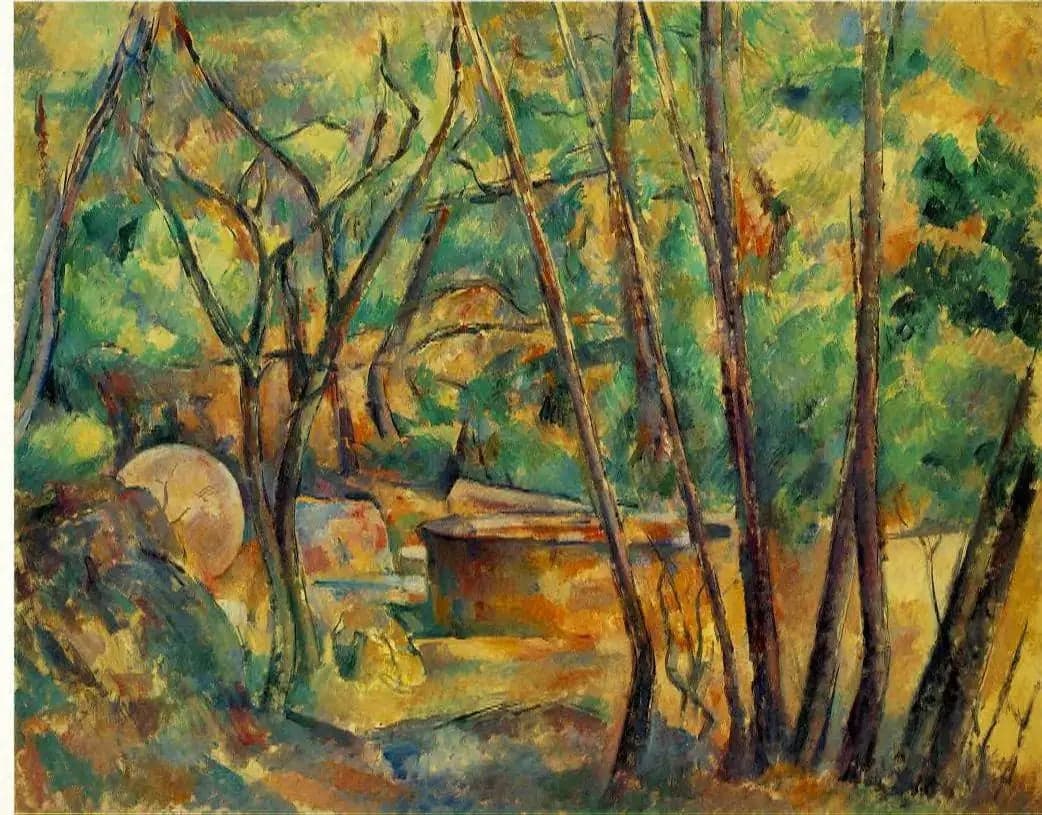
Mill and Water Tank in Underwood
- Original dimensions
- 81 x 65.1 cm
- Museum
- Barnes Foundation
- Year
- 1892
Scene depicted
In this canvas , Cézanne immerses us in the heart of a tranquil nature, where the harmony between the elements is expressed through the haystack, a symbol of rurality, and the water tank, a welcoming shelter for water, where the sky and earth meet. The lines of the painting intertwine, creating a visual symphony that calls for rejuvenation and meditation.
Historical context
Created in 1892, this painting masterfully captures the essence of the French countryside, more specifically in Aix-en-Provence, the cradle of impressionism . Paul Cézanne , a pioneer of modernity, saw in this painting the opportunity to merge his unique vision with the post impressionist movement, exploring light and form in a captivating harmony. Today, this painting is located at the Barnes Foundation , a true artistic treasure trove, where it can be admired in all its splendor.
Place in the artist's career
Haystack and Water Tank in Underwood is situated at a key moment in Cézanne's career, representing a transition to his period of artistic maturity. In comparison with The Montagne Sainte-Victoire and The Large Bathers , we see the evolution of his technique, increasingly yielding to bold compositions and a vibrant palette, thus elevating this composition to an almost iconic masterpiece of his journey.
Anecdote
“I want to finally push back the sky, using shapes and colors.” This quote, inspired by Cézanne's relentless quest to capture the moment, resonates with the emotional strength of Haystack and Water Tank in Underwood . Let us imagine the artist, one spring morning, observing the play of light through the foliage, his canvas ready to vibrate with the whisper of the leaves.