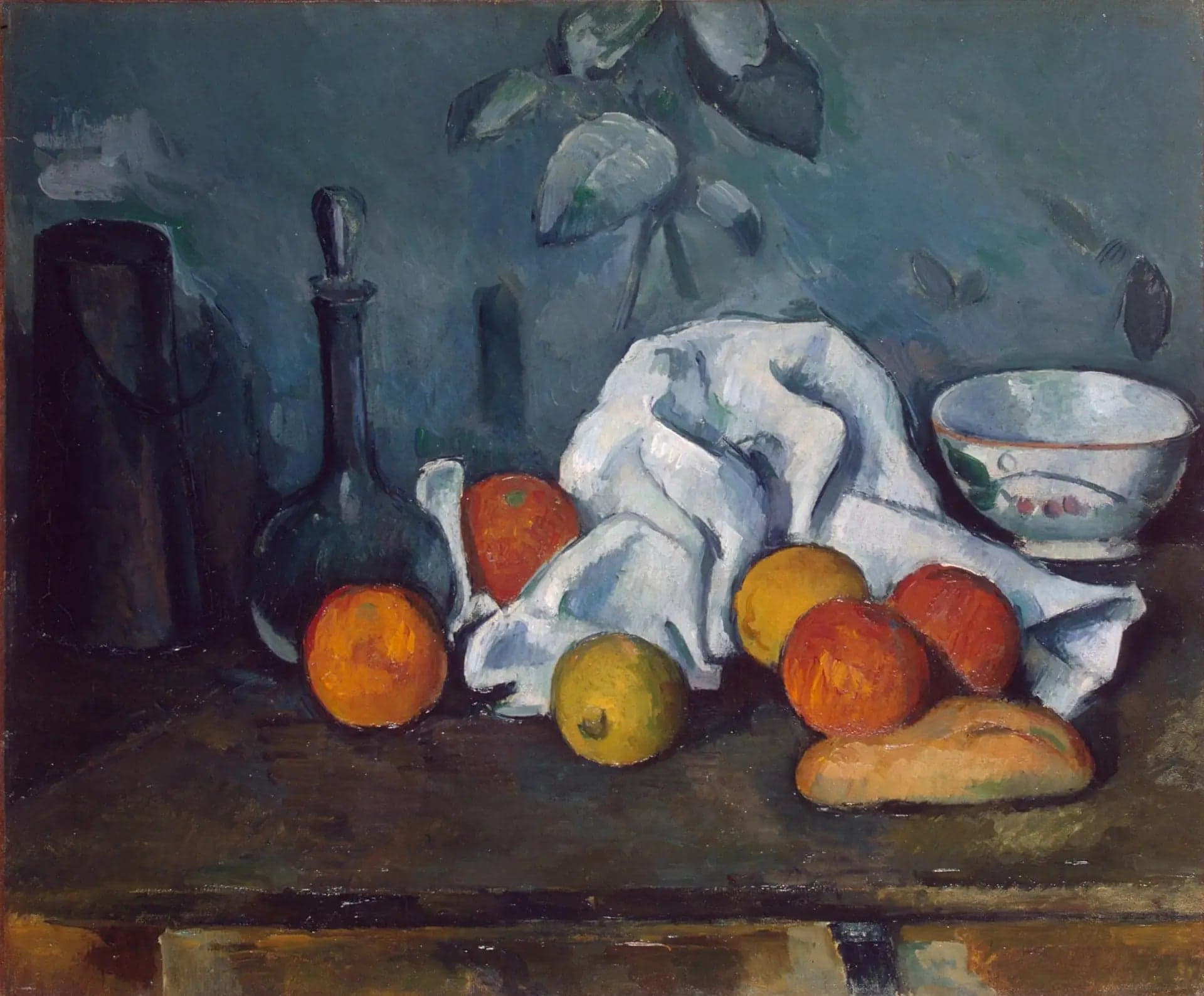
Milk box, carafe, and bowl
- Original dimensions
- 55.3 x 45 cm
- Museum
- Hermitage Museum
- Year
- 1879
Scene depicted
In this painting , Cézanne captures the very essence of everyday objects. The harmony of forms and colors brings the scene to life, transforming seemingly mundane elements into protagonists of a vast visual narrative. Each brushstroke testifies to Cézanne's passion for nature and the world around him, thus creating a painting vibrant with meaning.
Historical context
Created in 1879, this sublime painting is set against the historical backdrop of the late 19th century, a period marked by intense artistic evolution in France. At the heart of the Impressionist school, Paul Cézanne develops this canvas within a country undergoing transformation, where light and color redefine the vision of the world. The painting , now preserved at the Hermitage Museum , is a window opening onto the simple beauty of everyday objects, measuring 55.3 x 45 cm.
Place in the artist's career
Milk Jug, Carafe and Bowl marks a significant milestone in Cézanne's career, revealing his artistic maturation. This masterpiece is situated just before his major works such as The Large Bathers and The Montagne Sainte-Victoire, demonstrating a subtle transition towards more complex and bold compositions. The poetry of this painting is linked to an ambition for simplification, while maintaining an emotional depth that characterizes it.
Anecdote
“True beauty lies in simplicity, a bowl, a carafe, and the play of light,” Cézanne liked to say. Imagine a sunny morning, where the artist, in search of inspiration, observes these common objects that, through their arrangement, awaken a vibrant story within him. This filtered and revealed emotion in Milk Jug, Carafe and Bowl transports us to the heart of his pictorial work.