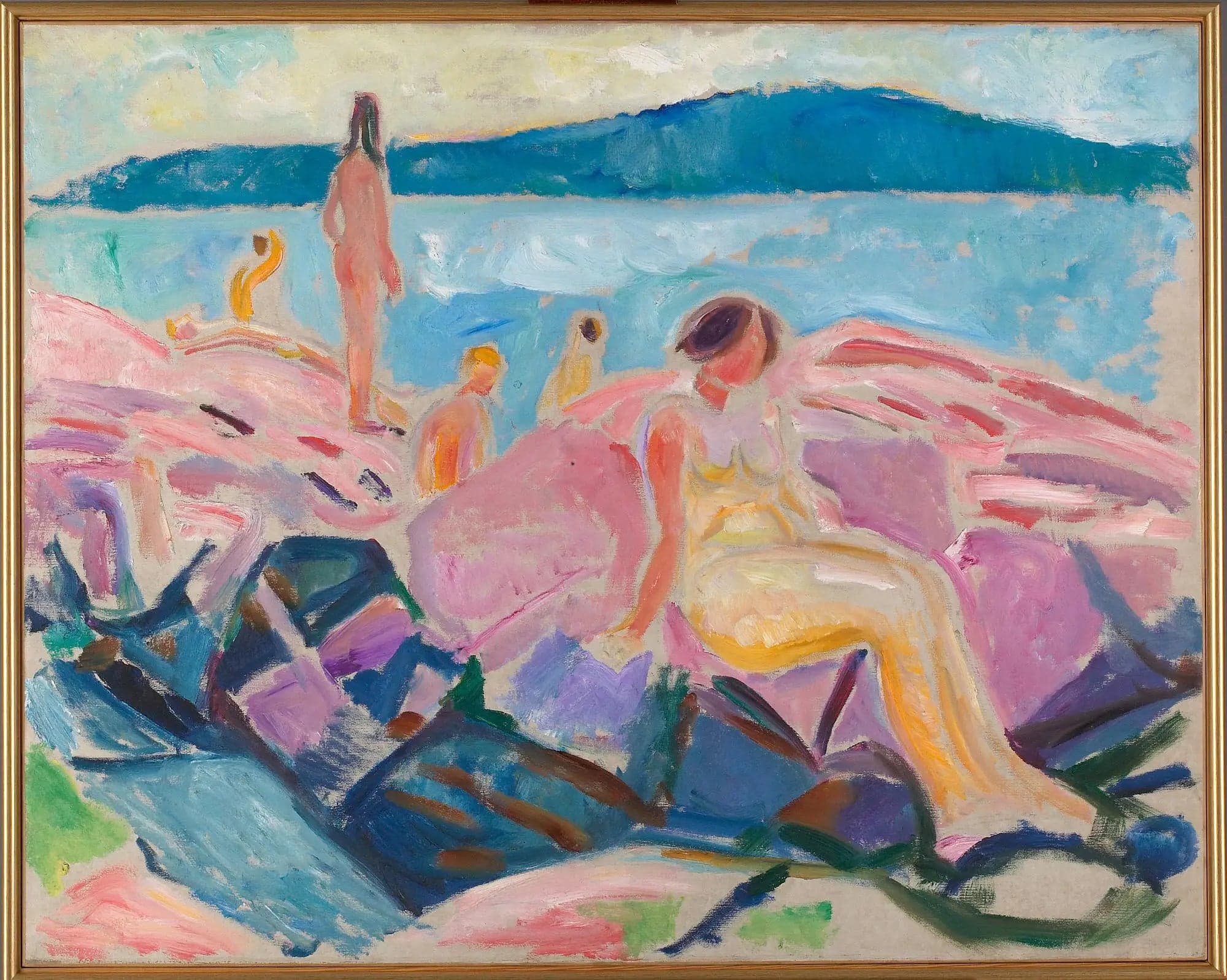
Mid-Summer
- Original dimensions
- 119.5 x 95.5 cm
- Museum
- Munch Museum
- Year
- 1915
Scene depicted
This composition evokes the fullness of summer, where human figures, bathing in a lush atmosphere, seem almost to dance in vibrant nature. The scene unfolds with emotional intensity, inviting the viewer to feel joy, while hinting at a latent melancholy characteristic of Munch's style.
Historical context
Created in 1915, this painting emblematic of Edvard Munch finds its roots in the expressionist movement, which redefines human emotions through art. The canvas evokes the summer intensity, while the Munch Museum in Oslo carefully preserves this unique work, a reflection of a troubled era full of contrasts.
Place in the artist's career
The painting "Mid-summer" represents a turning point in Edvard Munch 's career, marking his period of artistic maturity. It stands alongside other paintings emblematic like "The Scream" and "The Madonna," illustrating a connection between personal and universal emotions, while highlighting the evolution of his pictorial technique.
Anecdote
“Each canvas is a piece of my soul, a fragment of my past,” said Munch while reminiscing about the dense summer days when he painted. It is in a vibrant atmosphere, inspired by the blurred lights of a summer morning, that Mid-summer emerges, thus capturing the essence of the moment and the sensations that accompany it.
Major exhibitions
Edvard Munch and his models: 1912-1943