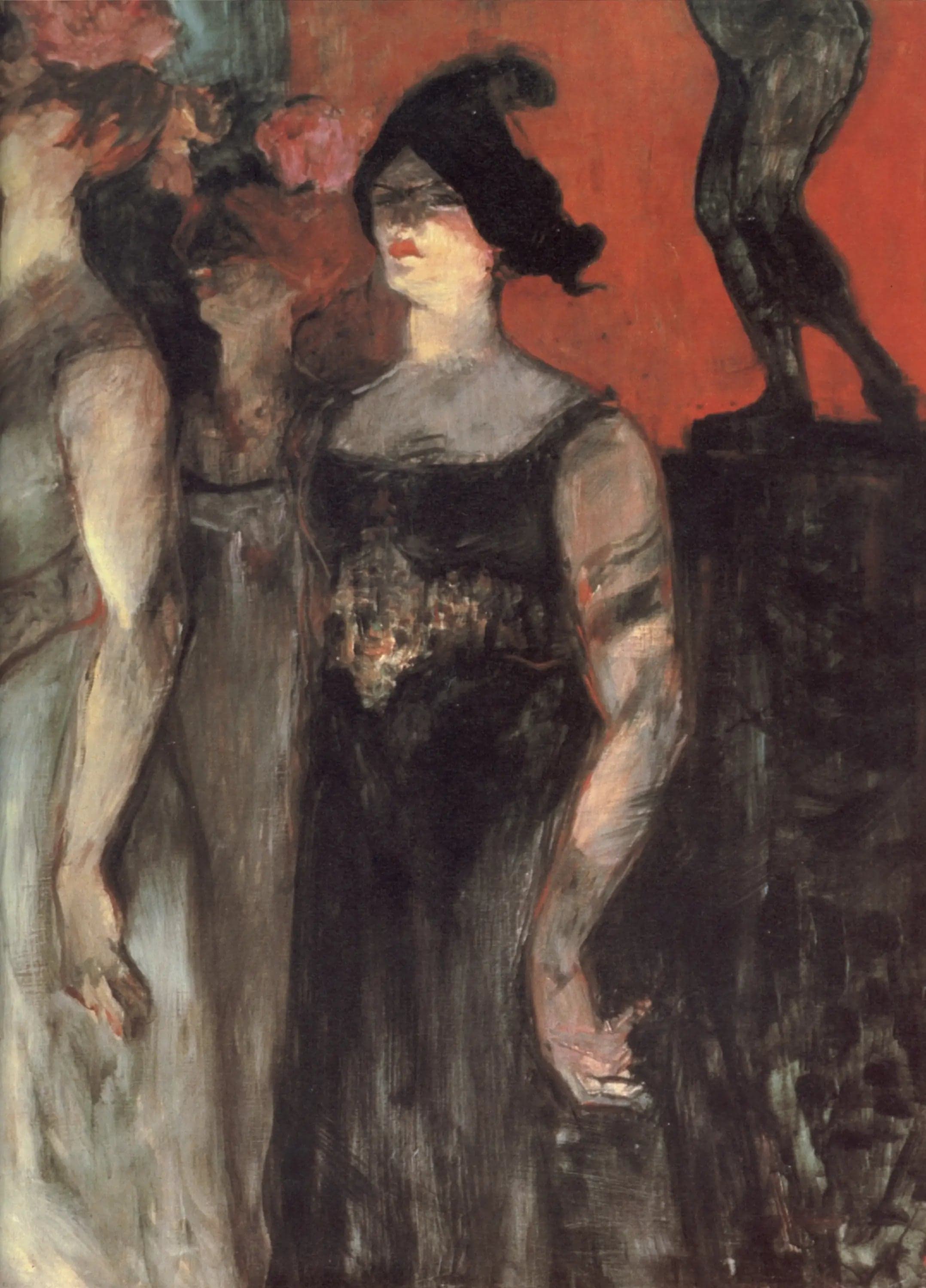
Messaline - Henri de Toulouse
- Original dimensions
- 79 x 98 cm
- Museum
- Princeton University Art Museum
- Year
- 1901
Scene depicted
Messaline , inspired by the famous Roman empress, unfolds in a captivating composition, combining both mystery and provocation. Toulouse-Lautrec takes us into the vibrant world of Parisian cabarets, where the brilliance of lights mingles with the shadow of secrets. An intoxicating atmosphere hovers over the painting , the fruit of a unique gaze on human nature and its delights.
Historical context
This iconic work, created at the end of the 19th century in Paris, is set in the vibrant context of the Post-Impressionist movement. Between the Belle Époque and the first tremors of Modernism , Messaline captures the artistic, social, and cultural effervescence of this golden age. The painting, currently housed at the Princeton University Art Museum , measures 79 x 98 cm, an ideal size to seed a living space with an unforgettable aura.
Place in the artist's career
This painting marks a pivotal moment in Toulouse-Lautrec's career. At this time, he boldly explores a style that embraces the essence of his subject, much like his other works, such as At the Moulin Rouge and Jane Avril at the Jardin de Paris , where he combines technical mastery and emotional sensitivity to penetrate the heart of a vibrant era.
Anecdote
Henri de Toulouse-Lautrec once confided: "Life is a painting of sensations, and each color is a memory." This masterpiece was born in a small Parisian café, bathed in the light of a spring awakening. The scent of croissants just out of the oven mingled with the laughter of the guests, memories frozen on the canvas forever. It is a lesson in intensity that explodes with every brushstroke of this painting .