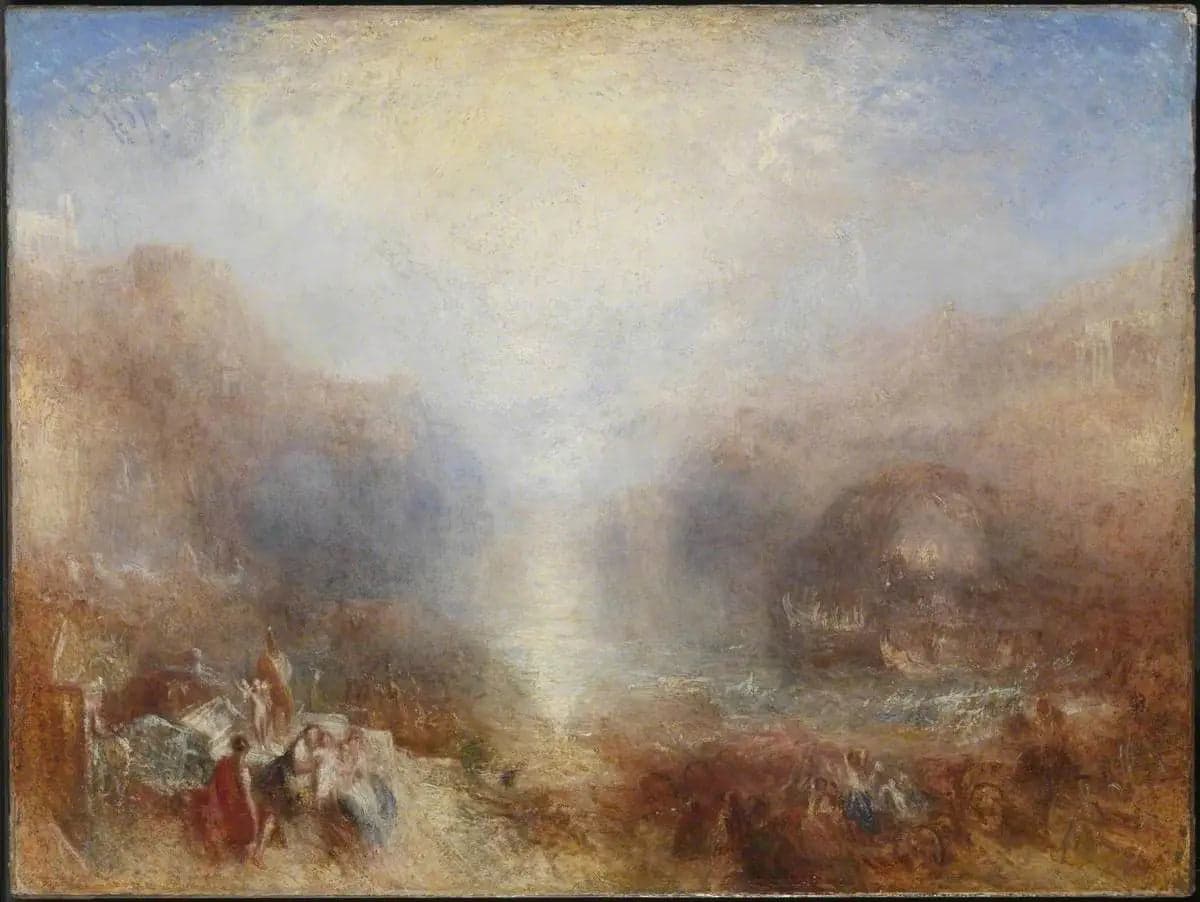
Mercury Sent to Admonish Aeneas
- Original dimensions
- 90.2 x 120.6 cm
- Museum
- Tate
- Year
- 1850
Scene depicted
At the heart of this pictorial work, Turner illustrates the crucial moment when Mercury descends to remind Aeneas of his glorious destiny. On a raging sea, the mythological figures come to life, while the brilliant light reflects the tumult of human emotions. This scene, blending mythology and sublime natural beauty, embodies the struggle between duty and desire.
Historical context
Created in 1850, this painting by the English master Joseph Mallord William Turner is an iconic piece of romanticism . The work was born in London, at the heart of an artistic era marked by a deep connection with nature and emotions. Turner, considered a leading figure of the movement, imbues this canvas with light and emotion, still on display in the renowned Tate museum in London. Its imposing dimensions of 90.2 x 120.6 cm invite a poetic immersion into the troubled world of the hero Aeneas.
Place in the artist's career
Mercury Sent to Admonish Aeneas represents a pivotal moment in Turner’s career. After promising beginnings with works such as The Fighting Temeraire, he reaches a new stylistic maturity here. This canvas also foreshadows profound works such as The Slave Ship and Rain, Steam and Speed, reflecting an evolution towards a more abstract and emotional painting.
Anecdote
“Light is my soul, and shadow, my muse.” In this frantic quest for visual expressions, Turner isolated himself one morning by the Thames, capturing the escape of a rising sun. This intimate moment, both fragile and powerful, nourished the embodiment of the sentimental painting that still resonates with those who cross its path, promising an introspective journey akin to that of Aeneas.