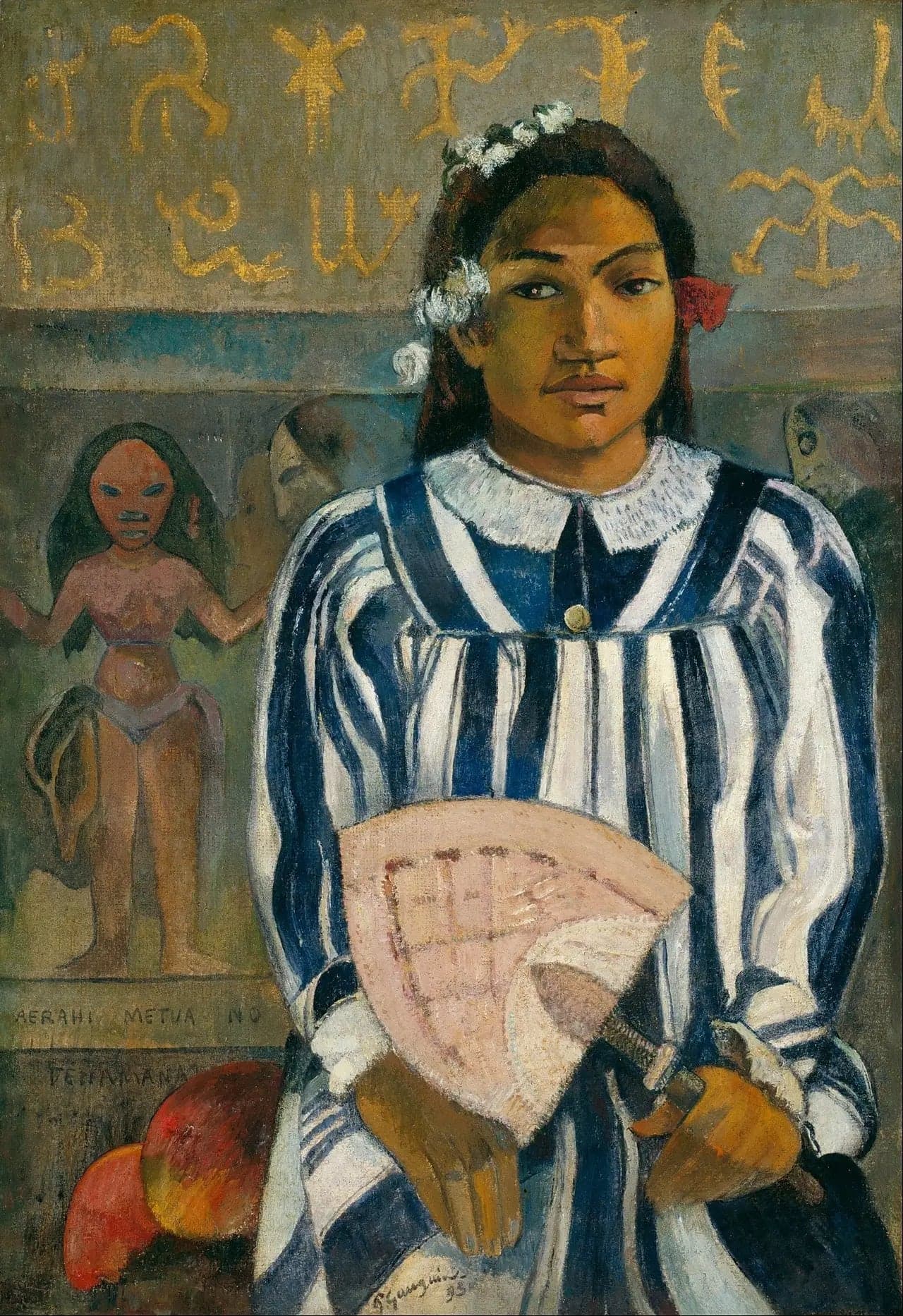
Merahi metua no Tehamana
- Original dimensions
- 54.3 x 76.3 cm
- Museum
- Art Institute of Chicago
- Year
- 1893
Scene depicted
The painting “Merahi metua no Tehamana” depicts a Polynesian woman, full of grace, evoking both the sweetness of her existence and the richness of her culture. The floral patterns and shades of lush green that surround her plunge us into an atmosphere of fullness, inviting us to contemplate the simple beauty of everyday moments. Through this painting , Gauguin wishes to pay tribute to a life connected to nature.
Historical context
This painting emblematic was created in 1893, when Paul Gauguin , pioneer of post-impressionism , immortalizes on his canvas the exoticism of the islands of Tahiti. Settled in this region of the South Seas, the artist immerses himself in the vibrant colors and bright lights that are a true tribute to Polynesian culture. Today, this masterful work is preserved at the prestigious Art Institute of Chicago , a sanctuary for art lovers. Its dimensions, equivalent to a large painting, invite the viewer to dive into the heart of its composition.
Place in the artist's career
“Merahi metua no Tehamana” represents a crucial period in the career of Paul Gauguin . Following his beginnings in conventional impressionism , he embraces a bolder and more spiritual style. This masterpiece symbolizes his commitment to a more personal art, particularly after works such as “Vision after the sermon” and “La Belle Angèle,” which testify to his relentless quest for authenticity.
Anecdote
Gauguin once declared: “I dreamed of a painting that would tell the souls of people through their gazes.” On a quiet morning in Tahiti, he crossed the gaze of a woman whose timeless beauty inspired him deeply. It is this authentic emotion that permeates the canvas “Merahi metua no Tehamana,” embodying a moment of intimate connection between the artist and his model.