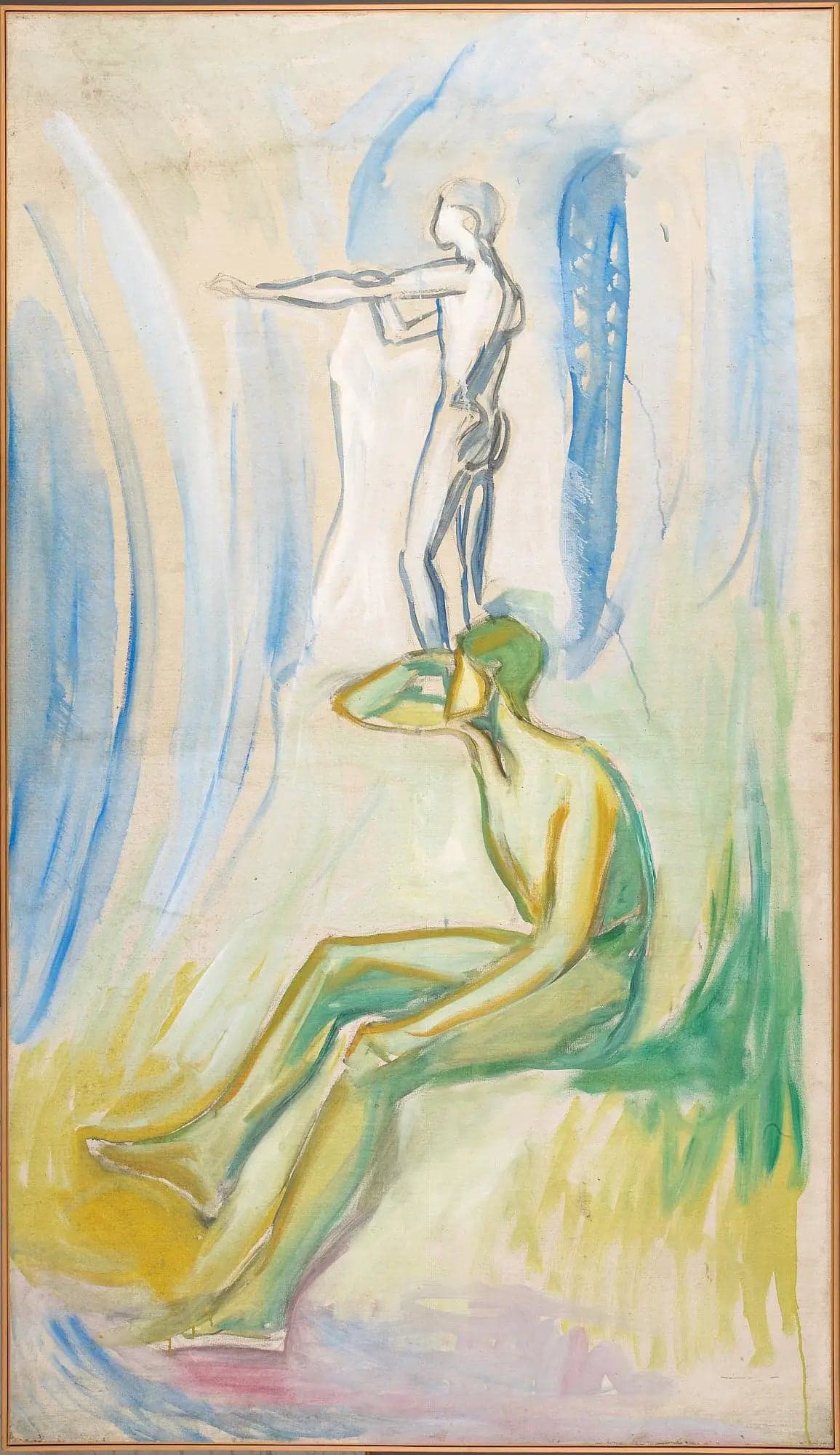
Men Turning Towards the Sun
- Original dimensions
- 104 x 180 cm
- Museum
- Munch Museum
- Year
- 1911
Scene depicted
In Men Turning Towards the Sun , Munch invites us to contemplate the poignant scene of male silhouettes, raising their faces towards the sky, in search of a connection with the source of light. This striking scene evokes human vulnerability and the desire for transcendence, thus exploring the universal themes of the search for meaning and hope through light.
Historical context
Created in 1911, the painting Men Turning Towards the Sun is set in the vibrant context of Oslo, a city at the heart of Norway, rich in remarkable culture and artistic history. This iconic work belongs to the expressionist movement, characterized by an emphasis on inner emotions rather than external reality. Today, the canvas resides on the walls of the Munch Museum, testament to the creative genius of Edvard Munch and the lasting impact of his work.
Place in the artist's career
This canvas marks a period of maturity in the career of Edvard Munch , following his previous works such as The Scream and The Madonna , which had already established his characteristic style. Men Turning Towards the Sun demonstrates the evolution of his technical approach, combining deep introspection with more open compositions and a bold use of color and light.
Anecdote
“The sunlight could heal the wounds of the soul,” Munch is said to have remarked while observing the power of the golden rays of a spring morning. It is this feeling that led him to create this masterpiece , inspired by the beauty and melancholy of human nature. Men Turning Towards the Sun thus becomes a reflection on the quest for light, both external and internal.