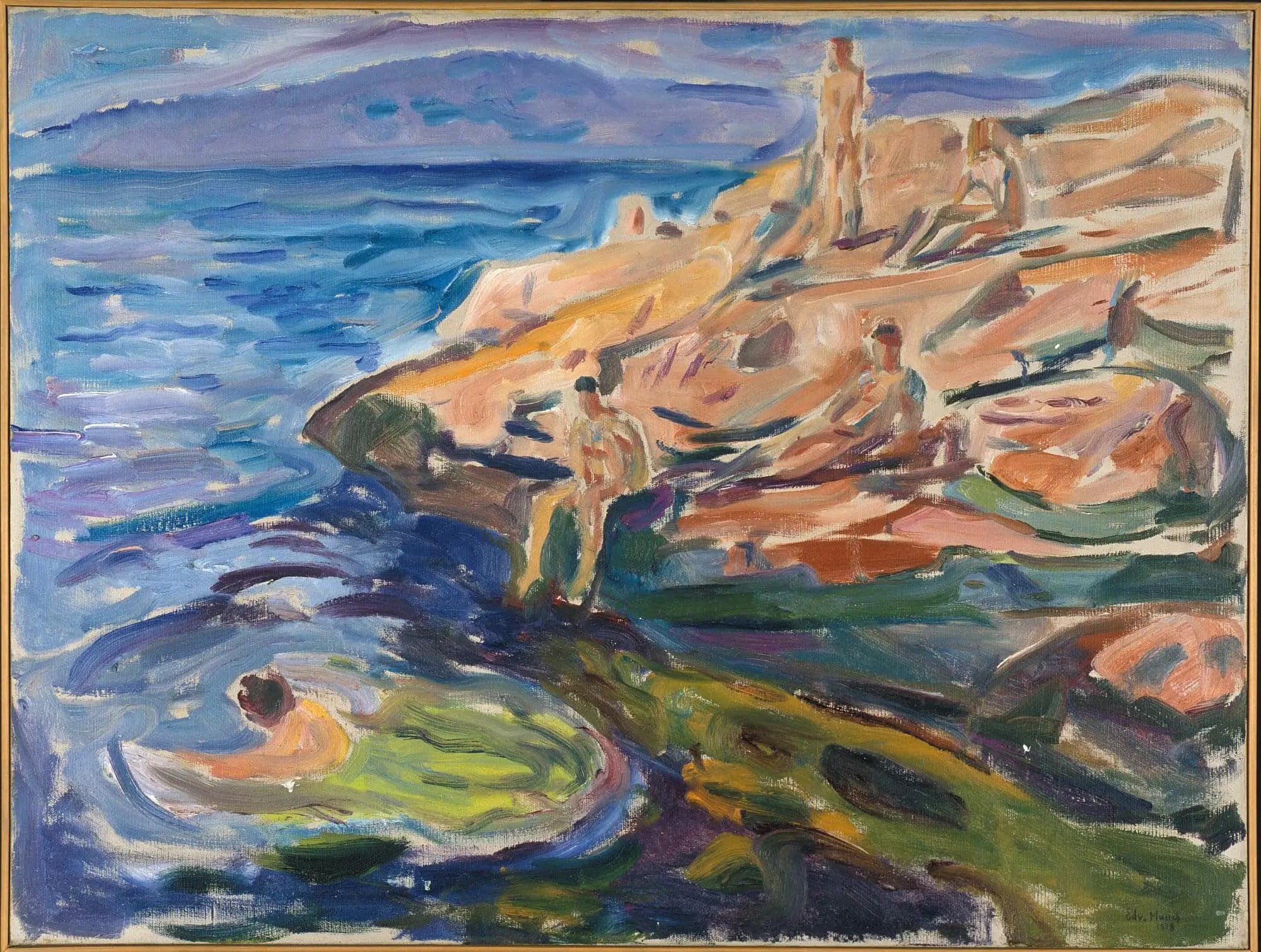
Men Bathing on the Rocks
- Original dimensions
- 177 x 158.5 cm
- Museum
- Munch Museum
- Year
- 1915
Scene depicted
The composition of Men Bathing on the Rocks illustrates a vibrant scene where men dive into turquoise waters, seeking freedom and escape. Each figure, emerging from the water to the surface, evokes the exhilaration of the moment, symbolizing the communion between man and the aquatic element. The fluid forms blend with the rocks, accentuating the unbreakable bond between the human body and nature.
Historical context
Created in 1915 in Oslo, Norway, this painting is emblematic of a crucial moment in the artistic corpus of Edvard Munch . Painting at the heart of the expressionist movement, Munch draws inspiration from coastal landscapes and moments of life bathed in the northern lights of his time. Currently exhibited at the Munch Museum, this canvas offers an immersion into the intimacy of men and nature.
Place in the artist's career
This painting, produced at a pivotal time in his career, reflects a notable stylistic evolution for Munch. At the same time, he also created works such as The Scream and The Madonna , where he explores themes of anxiety and human relationships. Men Bathing on the Rocks stands out for its bold approach and the fusion of joy with a dark atmosphere, showcasing an artistic maturity in full swing.
Anecdote
“Art must be the reflection of human passions.” This quote from Edvard Munch resonates deeply when discussing the genesis of this masterpiece . Imagine a summer morning, bathed in light, on the Norwegian coast; the whisper of the waves and the scent of sea salt inspired the painter to immortalize the dance of bodies on the rocks, in harmony with nature.