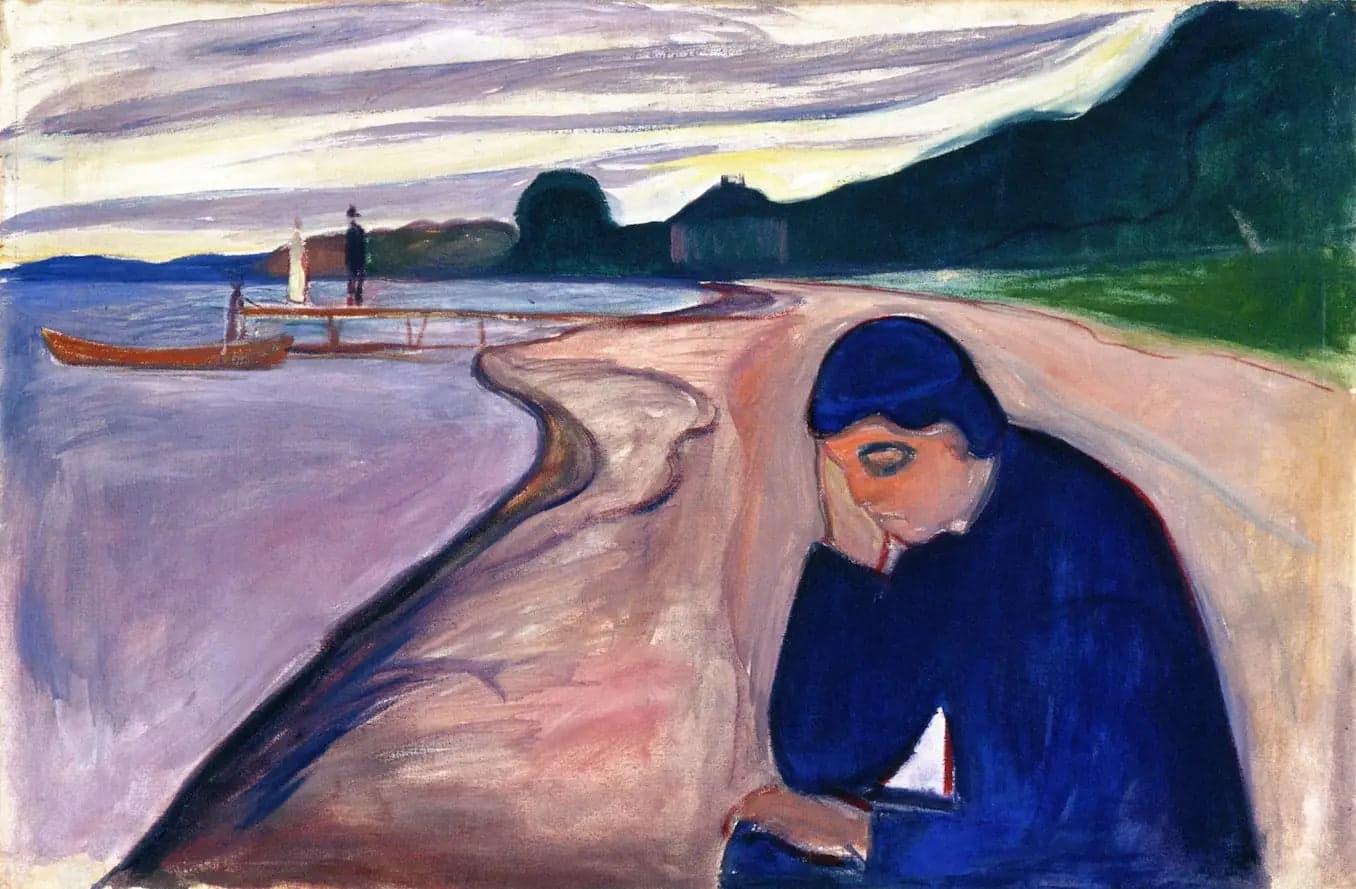
Melancholy
- Original dimensions
- 126 x 110.5 cm
- Museum
- Munch Museum
- Year
- 1900
Scene depicted
In the painting "Melancholy," Munch explores the deep abyss of the human soul through a dramatic and ethereal landscape. The image immerses us in a dense atmosphere, where a central character, lost in thought, faces a tormented backdrop. The dark colors and heavy sky express profound introspection, while the surrounding nature seems to resonate with inner suffering.
Historical context
Created in 1900, this painting is emblematic of its origins in Oslo, a vibrant city in Norway and a focal point of the expressionist movement. In a context of emotional upheaval and artistic transformations, Melancholy reflects Munch's personal thoughts on human suffering and anxiety. Currently exhibited at the Munch Museum, this canvas measures 126 by 110.5 cm, capturing the very essence of despair and dream.
Place in the artist's career
Melancholy represents a pivotal moment in Munch's artistic evolution, marking an emotional peak. Alongside The Scream and The Dance of Life , this painting showcases a stylistic maturity, where the expression of feeling takes a prominent place, demonstrating the journey towards mastery of visual emotions.
Anecdote
“I paint my dreams, not my reality.” These words from Edvard Munch evoke a misty morning in Oslo, where the breath of the wind through the trees inspired the masterpiece . In the solitude of a silent alley, the face of a woman crossed his mind, embodying the melancholy found in this painting .