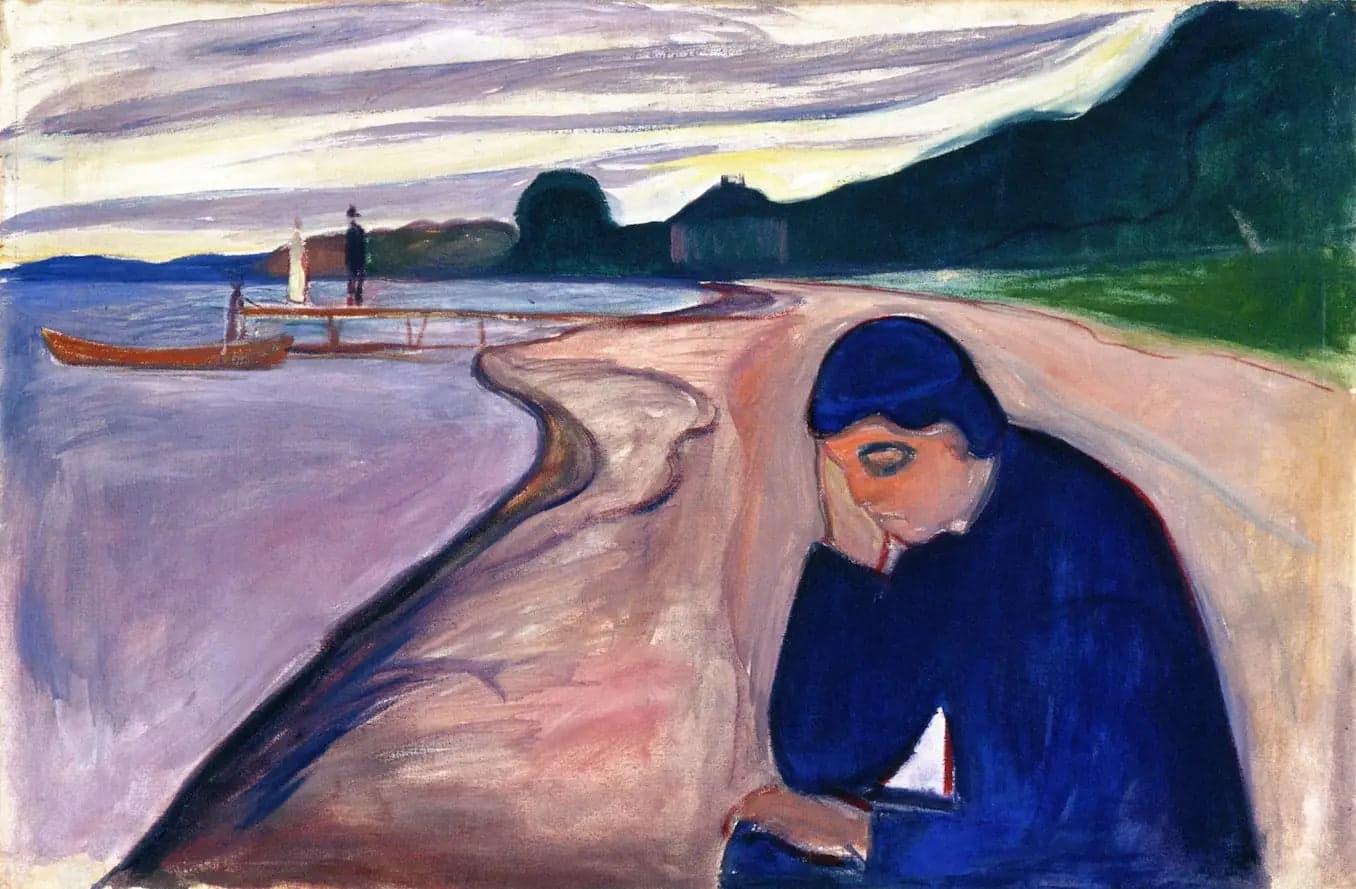
Melancholy
- Original dimensions
- 126 x 110.5 cm
- Museum
- Munch Museum
- Year
- 1900
Scene depicted
In the painting "Melancholy," Munch depicts an isolated figure, lost in thought, facing an infinite landscape. The dramatic composition and the mix of dark colors create a melancholic atmosphere, where introspection and sadness intertwine. This painting invites us to feel the depth of human emotions and to reflect on our own fragility.
Historical context
Created in 1900, the painting "Melancholy" is rooted in the heart of the expressionist movement, born in Oslo, Norway. This iconic painting is part of a period of significant artistic evolution where introspection and emotion take precedence over formalism. Currently, this canvas is on display at the Munch Museum, where it continues to fascinate visitors with its poignant atmosphere and psychological intensity.
Place in the artist's career
This painting represents a decisive turning point in Munch's career, marking a stylistic evolution towards free expression. Alongside works such as "The Scream" and "Love," "Melancholy" illustrates the maturity of his pictorial language and his ability to translate complex emotions into powerful visual forms.
Anecdote
“Melancholy is the color of memory,” Munch is said to have remarked while contemplating his works. Inspired by a soft twilight light, he captured a moment of solitude, a peaceful street where thoughts wander. This intimate connection between the artist and his painting highlights the evocative power of this painting , embracing the complex emotions that traverse human existence.