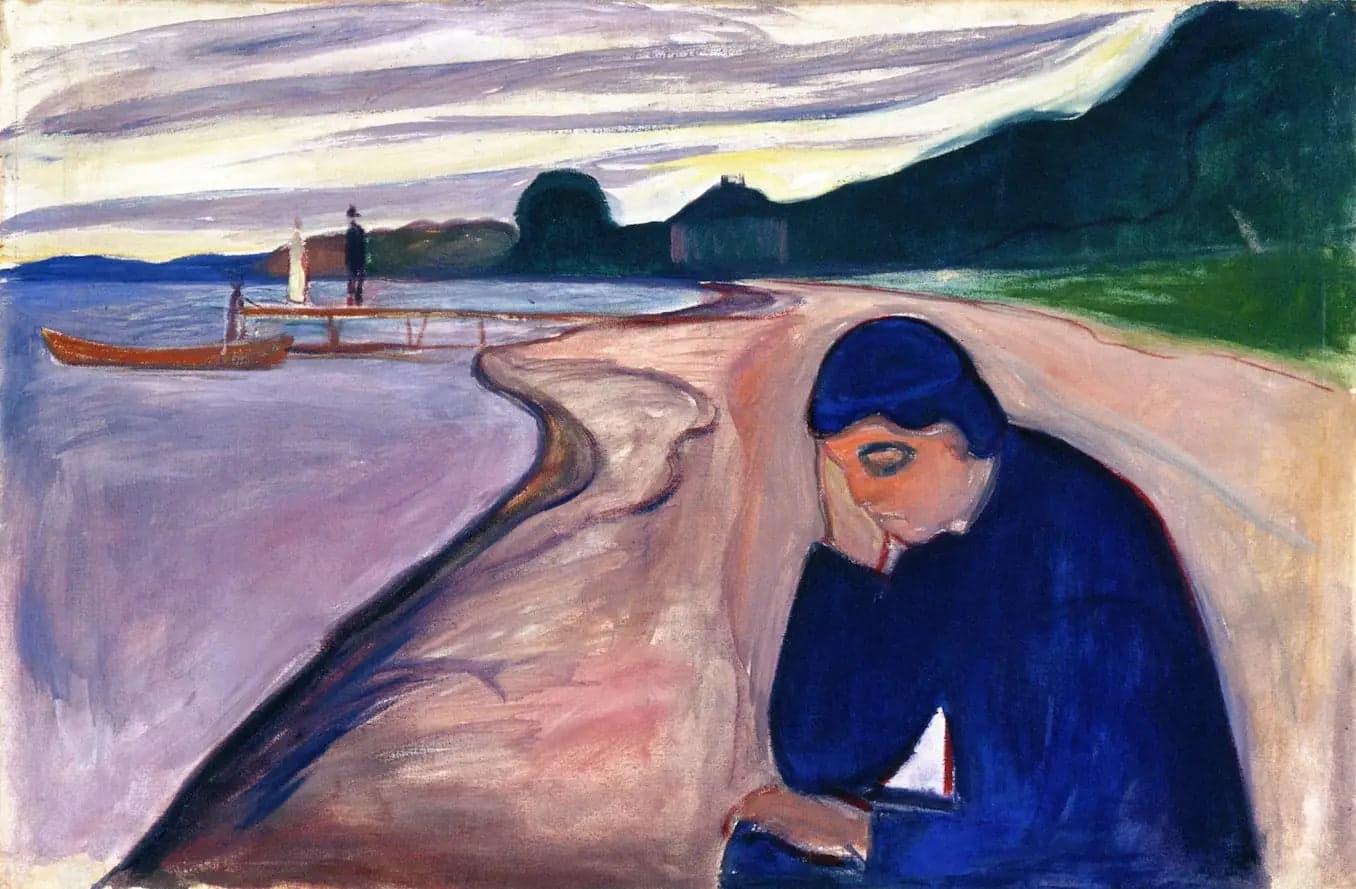
Melancholy
- Original dimensions
- 129 x 86 cm
- Museum
- Munch Museum
- Year
- 1893
Scene depicted
In the painting "Melancholy," Munch explores the depths of the human soul. A solitary silhouette is lost in dark thoughts, reflecting the inner struggle of the artist himself. The heavy clouds and dark landscape seem to resonate with the sadness that grips the central character, highlighting the intensity of isolation and melancholy.
Historical context
Created in 1893, in the vibrant city of Oslo, this painting is emblematic of the expressionist movement that foreshadows the emotional turmoil of the 20th century. Munch, with his vibrant pen, captured the anxieties of his time, feelings on edge. Today, the canvas rests majestically at the Munch Museum, where it continues to touch hearts and provoke thought.
Place in the artist's career
This painting represents a decisive turning point in Munch's career, marking a moment of stylistic maturity. It fits into a trajectory from his famous "The Scream" to "The Dance of Life," revealing the evolvability of his pictorial language. Each canvas testifies to his obsession with exploring human emotions.
Anecdote
Munch once shared: "Melancholy is an integral part of my life, it shapes my works just as much as daylight." It was on a foggy morning that this composition came to life, a scene marked by the silence of the deserted streets of Scandinavia.