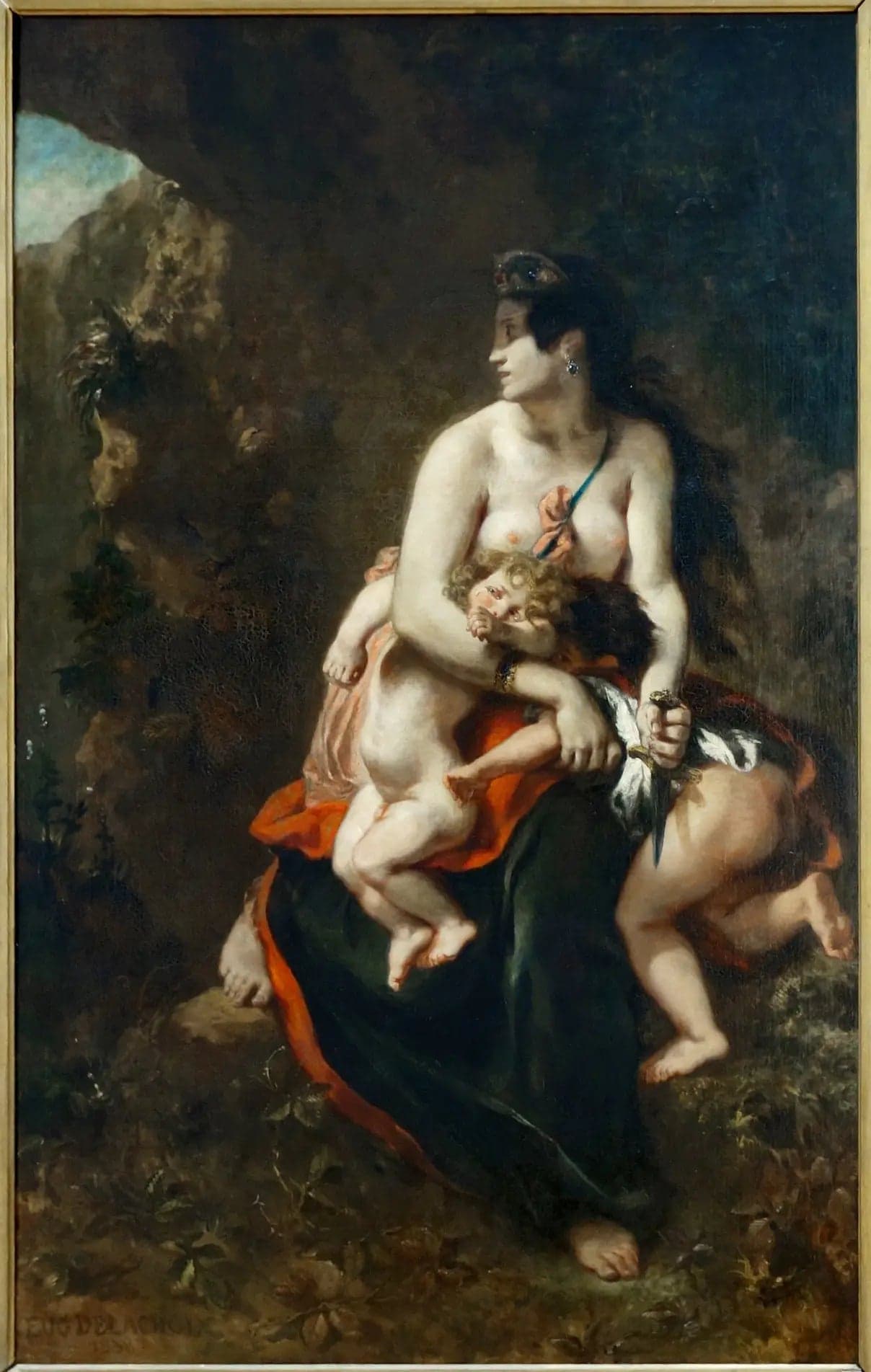
Medea in Fury
- Original dimensions
- 165 x 260 cm
- Museum
- Palais des Beaux-Arts de Lille
- Year
- 1836
Scene depicted
“Medea Furious” depicts a crucial moment in the legend of Medea, where rage and despair intertwine. The vivid colors and dynamic movements of this painting illustrate her fury, ready to break free from the chains of her fate. This canvas , with its intense narrative, captures a scene where inevitable tragedy unfolds, revealing the depth of human emotions.
Historical context
Created in 1836 within the vibrant framework of French Romanticism , the painting "Medea Furious" by Eugène Delacroix is part of the artistic heritage of the city of Lille, marked by an unprecedented cultural effervescence. This monumental canvas , with impressive dimensions, is now preserved at the Palais des Beaux-Arts de Lille , where it attracts an audience eager for emotions and pictorial narratives. The expressive power of this canvas reflects an era where art mirrors human passions.
Place in the artist's career
“Medea Furious” represents a turning point in the career of Eugène Delacroix , reaching undeniable stylistic maturity. Positioned after works such as “ The Death of Sardanapalus ” and before “ Liberty Leading the People ”, this painting reflects a technical evolution, combining movement with a bold palette.
Anecdote
“Inspiration rubs against pain…” said Delacroix when recalling his work on this iconic work . That spring morning, as he observed nature awakening, his thoughts intertwined with those of Medea, the tragic figure of mythology. The image of this woman consumed by her anger was born in the tumult of Parisian life, like a powerful cry against injustice.
Major exhibitions
Salon of 1838