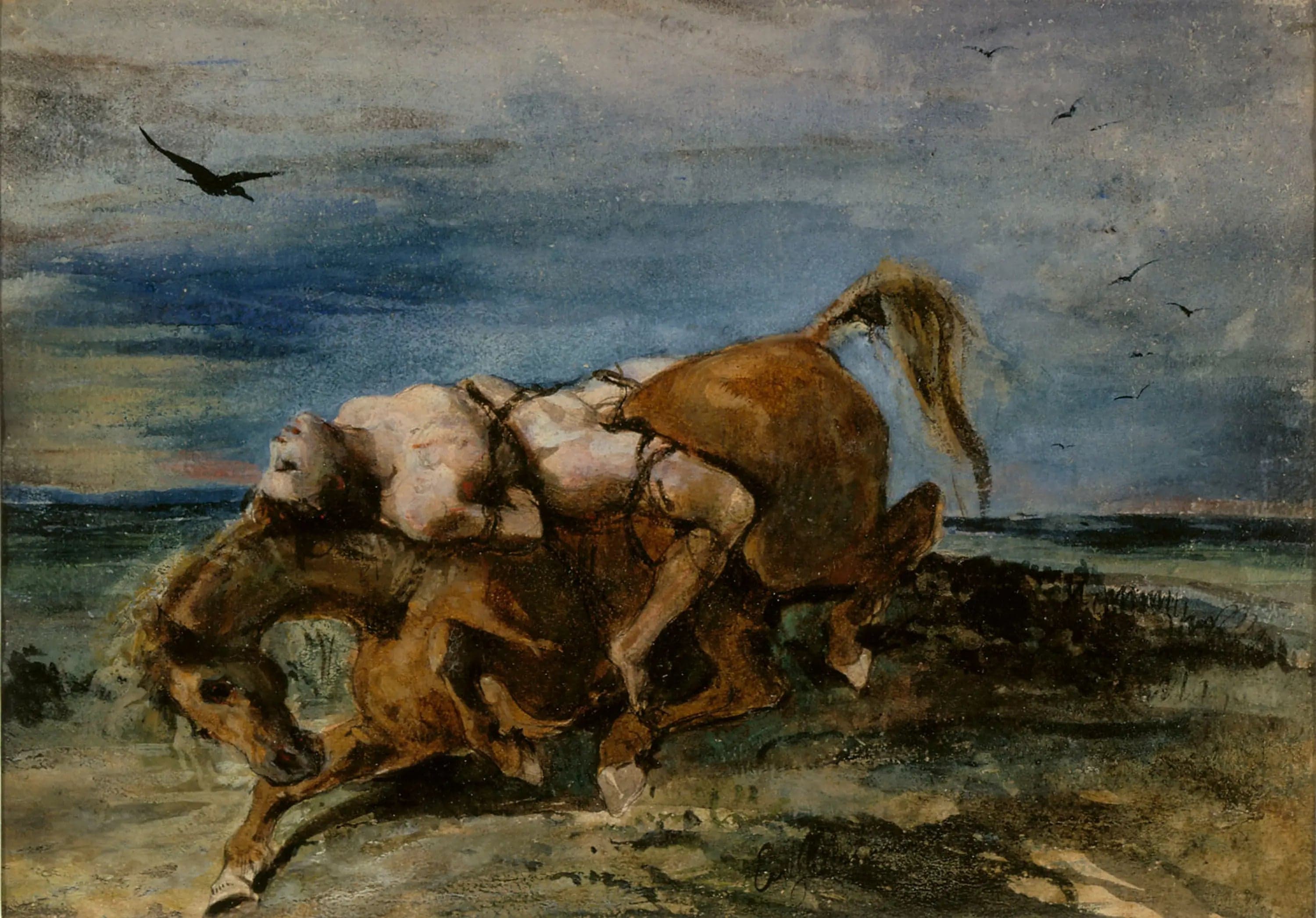
Mazeppa on the Dying Horse
- Original dimensions
- 31 x 22.5 cm
- Museum
- Sinebrychoff Museum
- Year
- 1824
Scene depicted
In this painting , we discover Mazeppa, bound and launched across the Ukrainian steppe on the back of a dying horse, a tragic composition that captures the struggle between man and nature. The striking movement and the character's distress speak of suffering and strength, of an indomitable struggle for survival, while the majesty of the landscape accentuates the drama of the scene.
Historical context
Artwork: Mazeppa on the Dying Horse |BRK| Artist: Eugène Delacroix |BRK| Year: 1824 |BRK| Museum: Sinebrychoff Museum |BRK| Dimensions: 31 x 22.5 cm |BRK|
Place in the artist's career
Mazeppa on the Dying Horse represents a turning point in Delacroix's career. It is here that the artist reveals himself in all his maturity, oscillating between the energy of Liberty Leading the People and the introspection of The Women of Algiers in Their Apartment . This painting perfectly illustrates the emotional and technical evolution of a burgeoning artist.
Anecdote
Delacroix once remarked: "Painting is the silent voice of the soul." Imagine the scene, a misty morning where, inspired by the thrill of Tchaikovsky's tales, he makes the first brush strokes to immortalize the heroic struggle of the tragic hero Mazeppa. This primordial emotion resonates in the evocative power of this canvas .