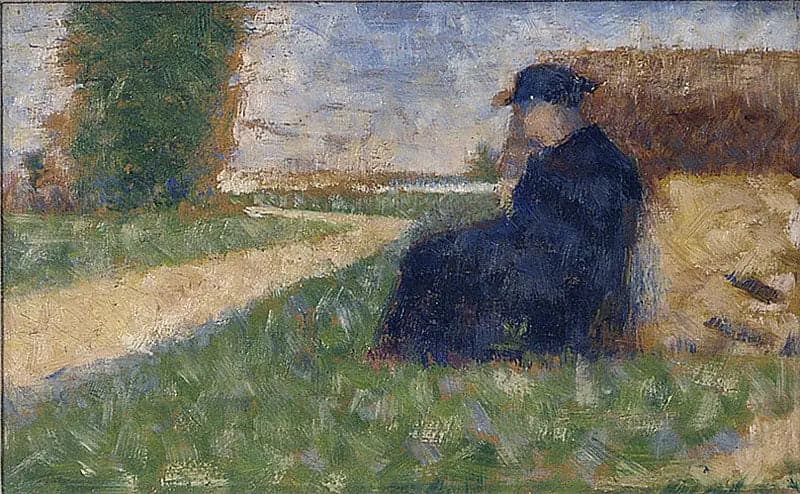
Massive figure in a landscape at Barbizon
- Original dimensions
- 24.8 x 15.7 cm
- Museum
- Wallraf-Richartz Museum
- Year
- 1882
Scene depicted
The painting “Massive Figure in a Landscape at Barbizon” depicts an imposing silhouette, omnipresent in a serene landscape. The composition evokes a delicate harmony between man and his environment, where every detail, every color, is carefully rendered to create a scene that seems to breathe. The interaction between light and forms accentuates the subtle movement of natural elements, exalting the idea of connection between human beings and nature.
Historical context
This oil painting , created in the idyllic setting of Barbizon, a village favored by impressionists , dates back to 1882. At that time, France, in the midst of artistic effervescence, saw the emergence of movements that questioned established norms. Seurat's painting is part of this dynamic, combining technique and freedom of expression. Today preserved at the Wallraf-Richartz Museum , this canvas of 24.8 x 15.7 cm bears witness to a pivotal moment in the history of art.
Place in the artist's career
This painting marks a turning point in Seurat's career, revealing him as one of the precursors of neo-impressionism . It follows iconic works such as “A Sunday Afternoon on the Island of La Grande Jatte” and precedes “The Eiffel Tower.” Here, Seurat explores new techniques, playing with dots and colors to achieve unparalleled depth.
Anecdote
Georges Seurat once stated: “Light is the key to color.” Indeed, it was during a walk in the softly lit countryside of Barbizon that the inspiration for this masterpiece came to him. The shades of vibrant greens and warm browns capture the very essence of this living nature, resonating even today in our collective imagination.
Major exhibitions
Paris 1863 – 1874: Revolution in Art