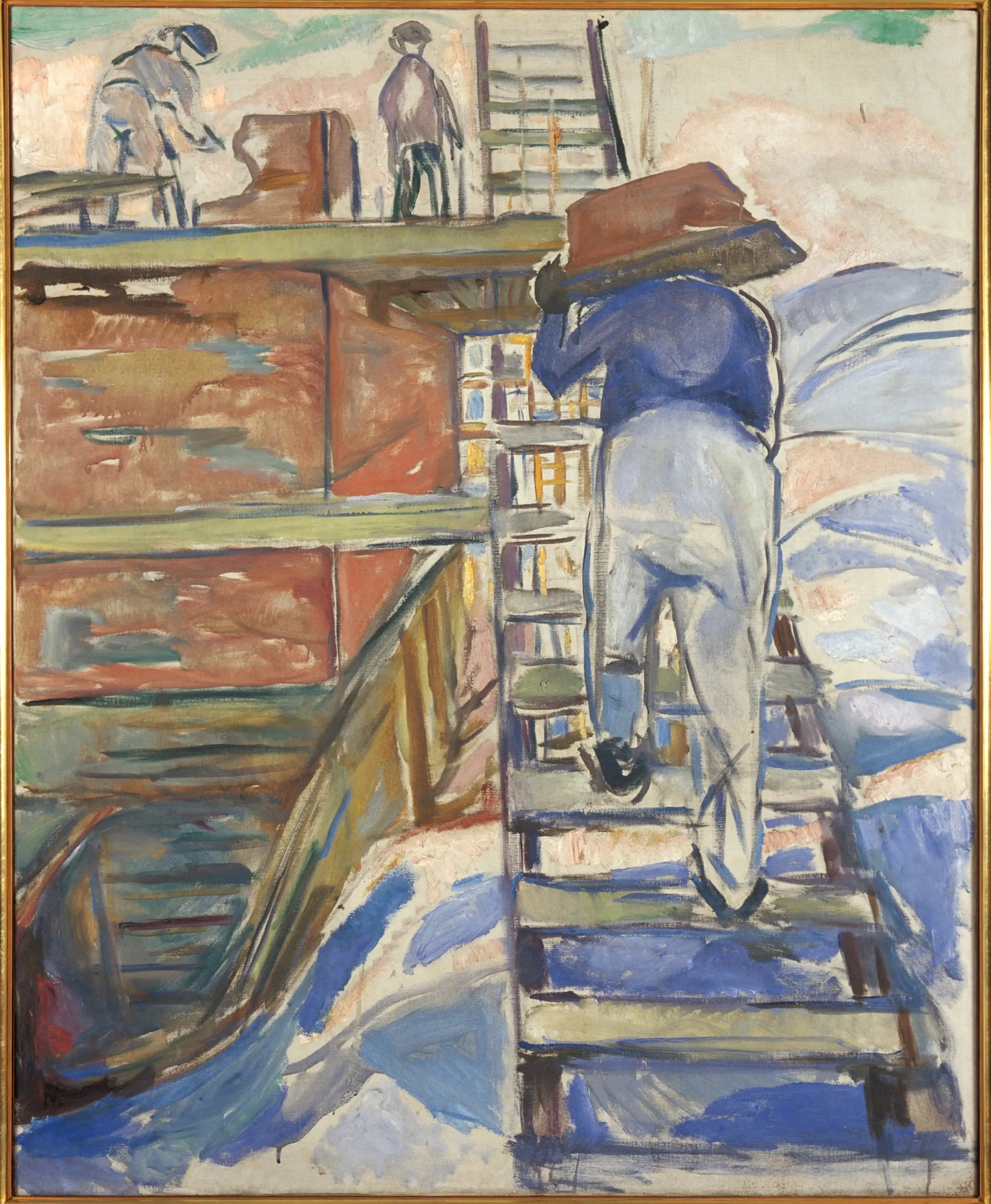
Mason on the Ladder
- Original dimensions
- 105.5 x 129.5 cm
- Museum
- Munch Museum
- Year
- 1920
Scene depicted
In “Mason on the Ladder,” Munch captures the essence of a man at work. The ladder, a symbol of ascent and effort, provokes reflection on human labor. The features of the man, both focused and thoughtful, engage us, evoking feelings of resilience and struggle in the face of daily life’s challenges.
Historical context
Created in 1920, “Mason on the Ladder” is a powerful testimony of the expressionist movement, illustrating an artist deeply rooted in the city of Oslo, Norway. This painting , now preserved in the Munch Museum, transports us to a time when chaotic emotions and internal struggles dominated the artistic landscape. This canvas , with a generous size of 105.5 x 129.5 cm, evokes an atmosphere where reality and individual sensitivity intersect.
Place in the artist's career
This canvas represents a pivotal phase in Munch's career, where his style begins to evolve towards greater introspection. Alongside other iconic canvases like “The Scream” and “The Madonna,” we can discern how the treatment of figures and emotions refines over time, traversing a period of intense exploration and expressive maturity.
Anecdote
“I have always wanted to capture life in its smallest details, even in what seems mundane.” Edvard Munch often expressed his desire to translate the challenging everyday into art. Imagine the artist in front of a construction site, the sound of the hammer resonating, the cool morning breeze brushing his face, while a golden light envelops his subject, inspiring this pictorial work .
Major exhibitions
Edvard Munch . Monumental projects