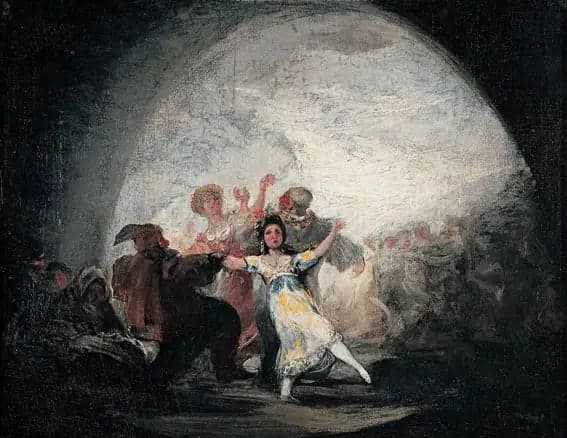
Masked Ball
- Original dimensions
- 30 x 38 cm
- Museum
- Not specified
- Year
- 1814
Scene depicted
The canvas , "Masked Ball," captures a moment of festivity and enigma. The dynamic composition illustrates masked figures, escaping the social conventions of their time, evoking a world of forbidden pleasures. The viewers become witnesses to a delicate dance, where each mask hides a story, an intention, a deep truth, thus blending the ordinary with the extraordinary.
Historical context
Created in 1814, in Madrid, the painting "Masked Ball" is part of the emerging romantic movement, reflecting the passions and tensions of its time. In the heart of Spain, Goya immerses us in an atmosphere that is both intriguing and narrative, a scene enveloped in mystery that attracts the curious and the learned. The canvas is not currently housed in a public museum, but its legacy remains vibrant and relevant.
Place in the artist's career
In Goya's career, "Masked Ball" represents a significant turning point. It is both a stylistic peak and a reflection of his inner turmoil. Compared to other canvases such as "The Naked Maja" and "The Charge of the Mameluke," we observe an evolution towards a deeper emotional intensity, marking a period of maturity in his painting .
Anecdote
Francisco de Goya once stated: "True beauty is that which is born of shadow and light." It was in the midst of a spring silence, while wandering through the streets of Madrid, that he captured the fleeting essence of the masked ball, transforming a simple observation into a captivating pictorial work . The evocative power of this moment will be forever etched in his masterpiece .