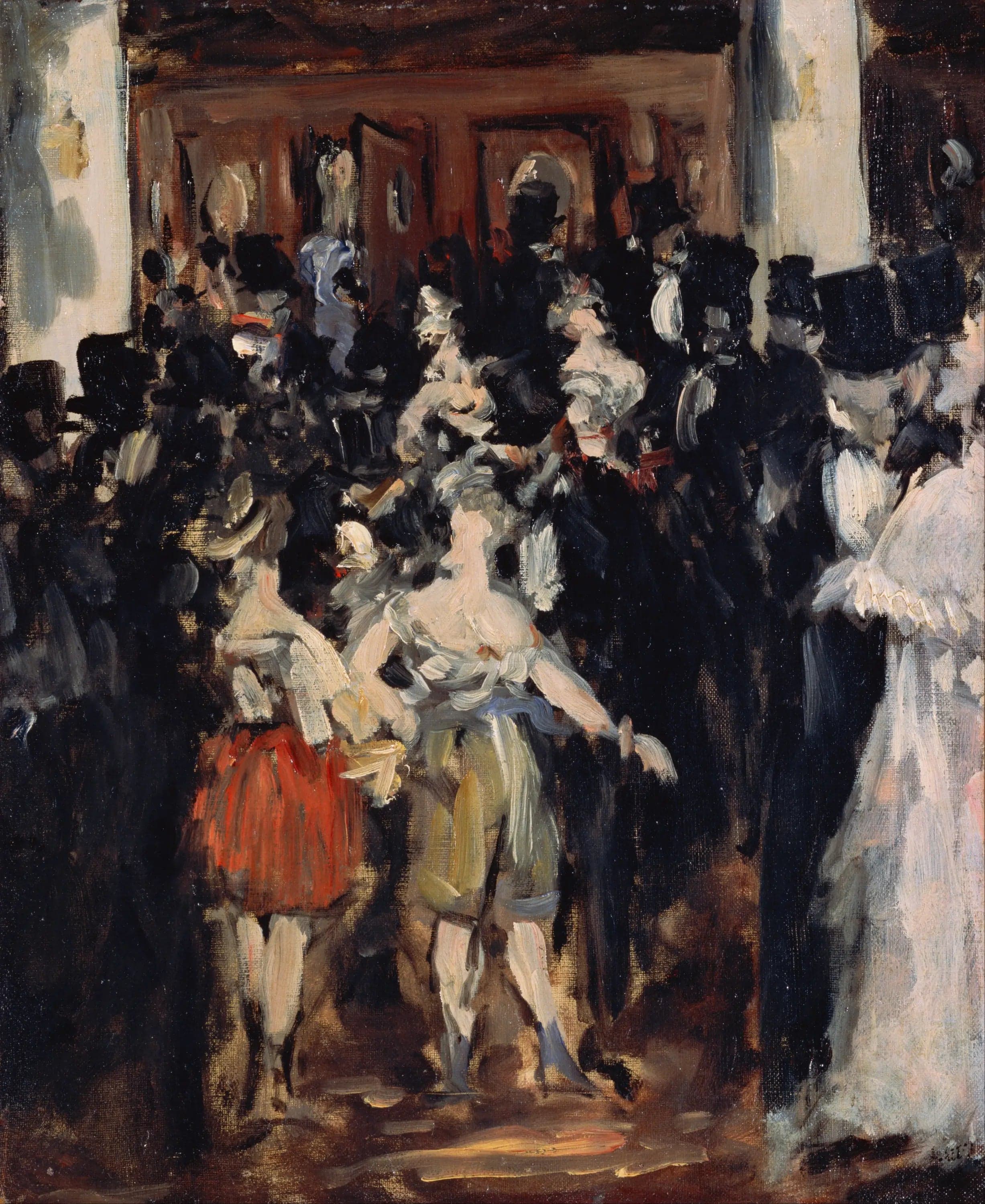
Masked Ball at the Opera
- Original dimensions
- 72.5 x 59.1 cm
- Museum
- National Gallery of Art
- Year
- 1873
Scene depicted
This painting, “Masked Ball at the Opera,” depicts a festive scene where the elegance of costumes clashes with the refined whispers of guests. Manet immortalizes the movement of the dance and the lightness of an evening where every exchanged glance creates an atmosphere charged with emotion. There, the viewer is invited to enter a universe of hidden portraits and sparkling lights, where the art of Parisian living flourishes.
Historical context
The year 1873 represents a turning point for art in Paris, a time when the Impressionist movement is just emerging. Édouard Manet , an iconic figure of this artistic period, captures the magic of a masked ball at the Opera in this vibrant painting . This canvas currently finds its place within the National Gallery of Art , reflecting the artistic heritage of a city in full cultural effervescence.
Place in the artist's career
This painting marks the peak of an artistic reflection for Manet, oscillating between realism and pre- Impressionism . Echoing his previous works like “Luncheon on the Grass” and “Olympia,” this composition illustrates his ability to capture the intensity of human life in a new light, while exploring light and shadow with mastery.
Anecdote
“Each ball tells a story, where mystery and identity intertwine in a fascinating dance.” These words resonate as Édouard Manet lets himself be inspired by the effervescence of the Opera, imaginary and imbued with velvet. It is in this atmosphere that the masterpiece comes to life, one morning filled with soft lights and exquisite fragrances.