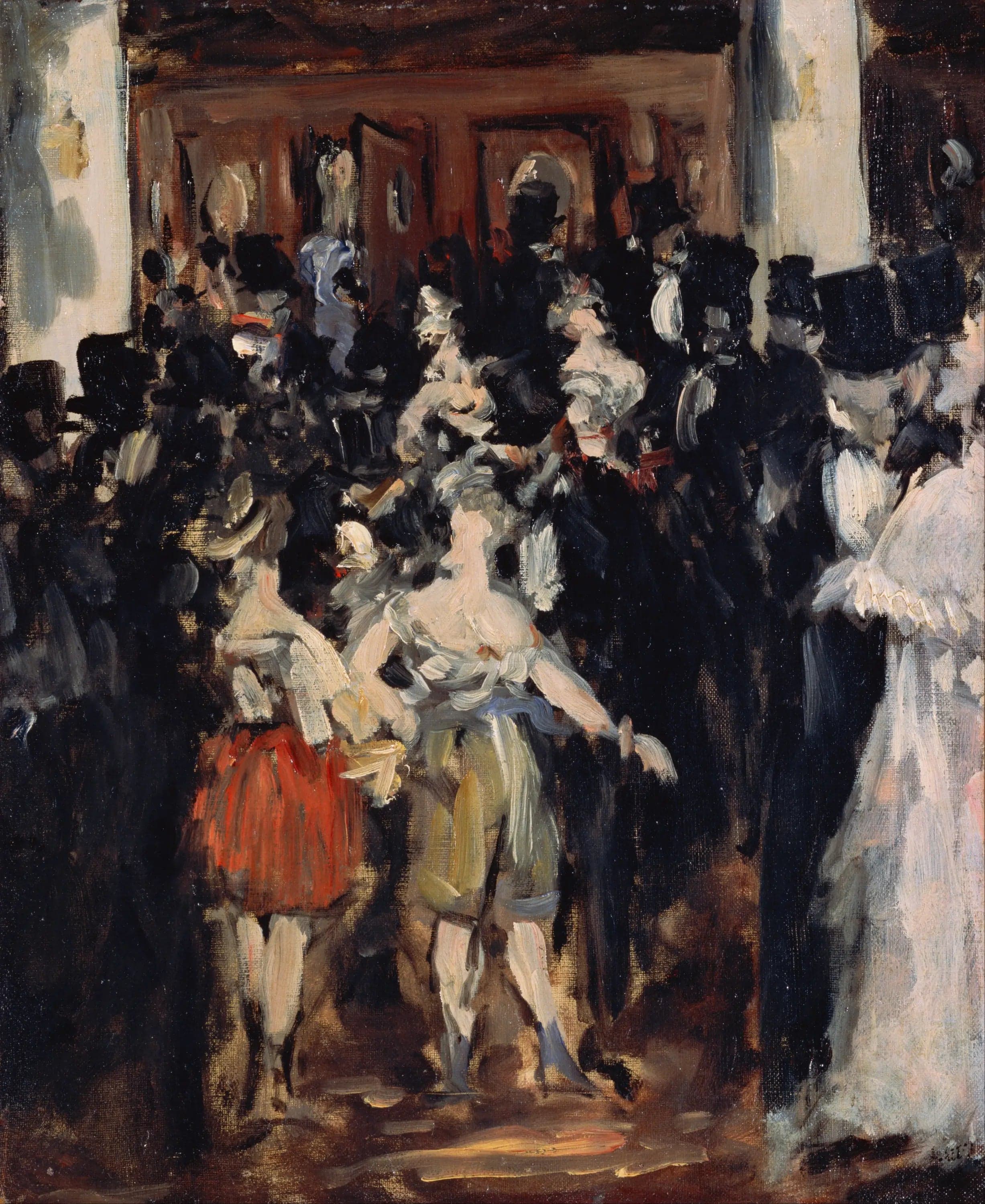
Masked Ball at the Opera
- Original dimensions
- 27 x 35 cm
- Museum
- Not specified
- Year
- 1873
Scene depicted
In the painting “Masked Ball at the Opera,” Manet immerses the viewer in a muffled universe, where the eyes are masked but the emotions, revealed. Through his bold brushstrokes, he offers a snapshot of Parisian high society, animated by plays of light and colorful costumes. This art of the scene, vibrant and full of life, tells the story of a time when every exchanged glance could be laden with a secret promise.
Historical context
Created in 1873, this painting emblematic finds its origin in the heart of Paris, a city in full cultural effervescence. Manet, a major figure of the Impressionist movement, captures the splendor of a masked ball, a popular social event at the time, where opulence and mystery intertwine. This canvas is unverified in a collection, but its dimension, 27 x 35 cm, makes it all the more precious to the viewer's eye.
Place in the artist's career
The painting “Masked Ball at the Opera” stands as a milestone in Manet's career, marking a turning point in his exploration of human interactions. Alongside “Luncheon on the Grass” and “Olympia,” this canvas illustrates his journey towards a freer, unbridled style, where expression takes precedence over strict academic representation.
Anecdote
“Art must be a celebration of the senses, a visual feast,” Manet might have said while contemplating the ball. Inspired by the festive atmosphere of a carnival evening, he cast on his canvas a vibrant composition, where each face is a mystery. This pictorial work is the echo of an era, a breath of life immortalized on the canvas .