Mars
- Original dimensions
- 48 x 72 cm
- Museum
- Moderna Museet
- Year
- 1919
Scene depicted
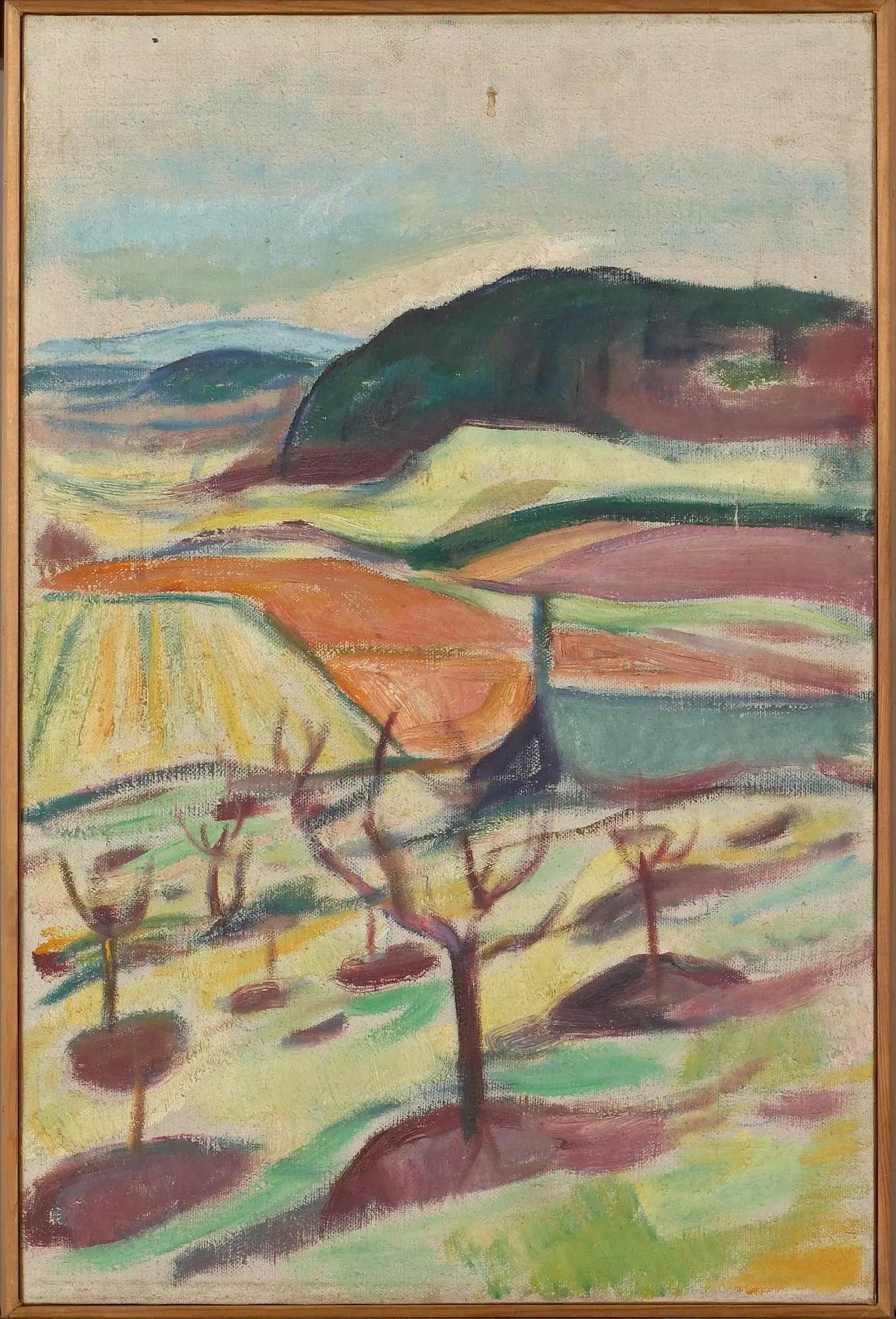
In this pictorial work, Munch expresses the duality between life and death, staging a tumultuous sky and dancing shadows that seem to intertwine with human forms. The painting depicts an inner struggle, where each color and stroke contributes to a complex and disturbing narrative.
Historical context
Created in 1919, in Stockholm, this painting embodies the essence of the expressionist movement, rich in emotions at a time when Europe was trying to rebuild after the war. This canvas is now displayed at the Moderna Museet, where it continues to captivate visitors with its evocative power and unique visual language.
Place in the artist's career
“Mars” is at the heart of Munch's stylistic transition, marking a period of maturity after iconic works such as “The Scream” and “The Madonna.” This painting testifies to an evolution towards bolder abstraction, capturing deeper and darker emotions.
Anecdote
“I paint what I feel and not what I see.” Such were the words of Edvard Munch , inspired by a spring morning in a quiet street in Oslo, where a mysterious atmosphere fertilized his imagination. The painting “Mars” is the poignant reflection of a tormented inner world.