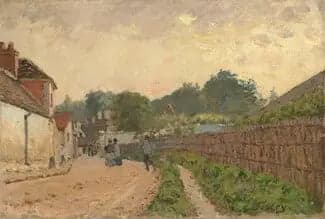
Marly-le-Roi
- Original dimensions
- 56.2 x 38.1 cm
- Museum
- National Gallery of Art
- Year
- 1875
Scene depicted
This painting illustrates a peaceful scene of the river, where light plays on the shimmering waves. Sisley succeeds in conveying an atmosphere of tranquility, inviting the viewer to dive into this sweet reality created by nature. The canvas reveals the harmonious interaction between man and his environment, capturing the essence of moments suspended in time.
Historical context
Created in 1875, this painting is emblematic of the Impressionist movement, of which Alfred Sisley was one of the major figures. Evoking the bucolic charm of the Parisian region, the scene of Marly-le-Roi captures the reflections of a fleeting moment. Today, this canvas carefully preserved at the National Gallery of Art , transports us to the heart of the artistic evolution of this vibrant era.
Place in the artist's career
Positioned within Sisley's work, Marly-le-Roi stands out as a period of maturity. Compared to his painting “Impression, Sunrise” and “The Bridge at Villeneuve-la-Garenne,” this canvas reveals his technical and emotional evolution, while affirming his unique style and love of nature.
Anecdote
Alfred Sisley once stated: “Nature is my best teacher.” Inspired by the enchanting landscapes of Marly-le-Roi, he captures in this masterpiece the gentle whisper of the wind and the delicate light of a morning. This moment of communion with nature has nourished the evocative power of this painting , filled with personal memories and emotions.