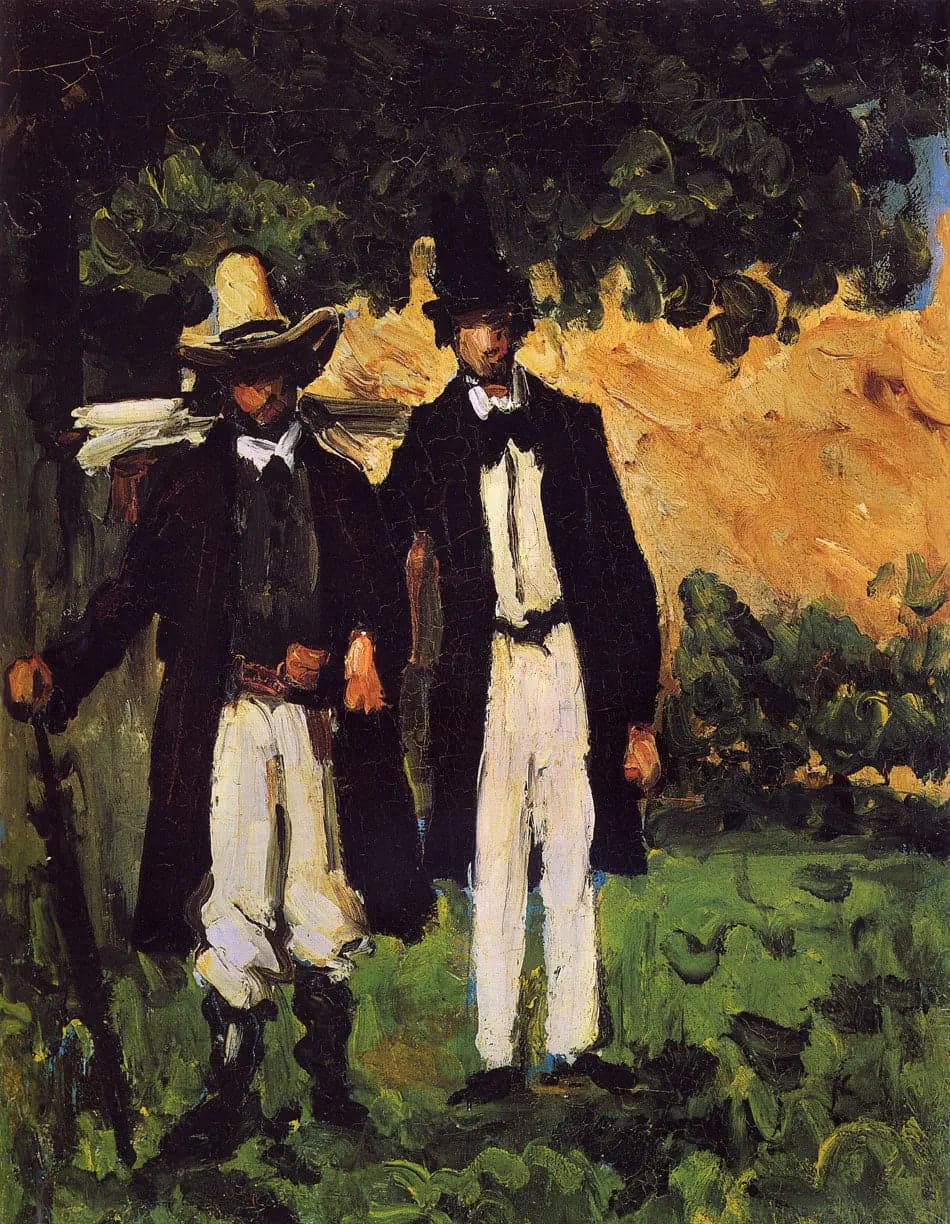
Marion and Valabrègue leaving for the motif
- Original dimensions
- 31.6 x 40.4 cm
- Museum
- Soumaya Museum
- Year
- 1866
Scene depicted
This vibrant painting narrates the emotional story of two figures, Marion and Valabrègue, preparing to leave the city to draw inspiration from the surrounding landscapes. The apparent simplicity of this scene conceals a philosophical depth, gracefully illustrating the interaction between man and his environment, resonating with the central themes of nature and the Provençal decor.
Historical context
Created in 1866 in the heart of Aix-en-Provence, this painting embodies the sensitivity of Impressionism and the beginnings of Post-Impressionism , bridging tradition and modernity. Here, Cézanne, a pillar of artistic modernity, captures the essence of the Provençal landscapes while initiating his dialogue with light and form. Today, this canvas resides at the Soumaya Museum , where it reveals itself to art lovers in all its splendor.
Place in the artist's career
Marion et Valabrègue partant pour le motif stands as a pivotal piece in Cézanne's career, marking his emergence as a master of light and color. By placing it alongside La Montagne Sainte-Victoire and Les Joueurs de cartes , we observe here a technical evolution that will lead him to forge his unique and personal style, reflecting his relentless quest to represent reality.
Anecdote
“Art is a reflection of nature,” Cézanne might have said one spring morning while observing the beauty of his surroundings. This quote, rooted in his mind, resonates deeply in Marion et Valabrègue partant pour le motif , where each color is a tribute to the light of Aix-en-Provence, where art and nature intertwine in a divine manner.