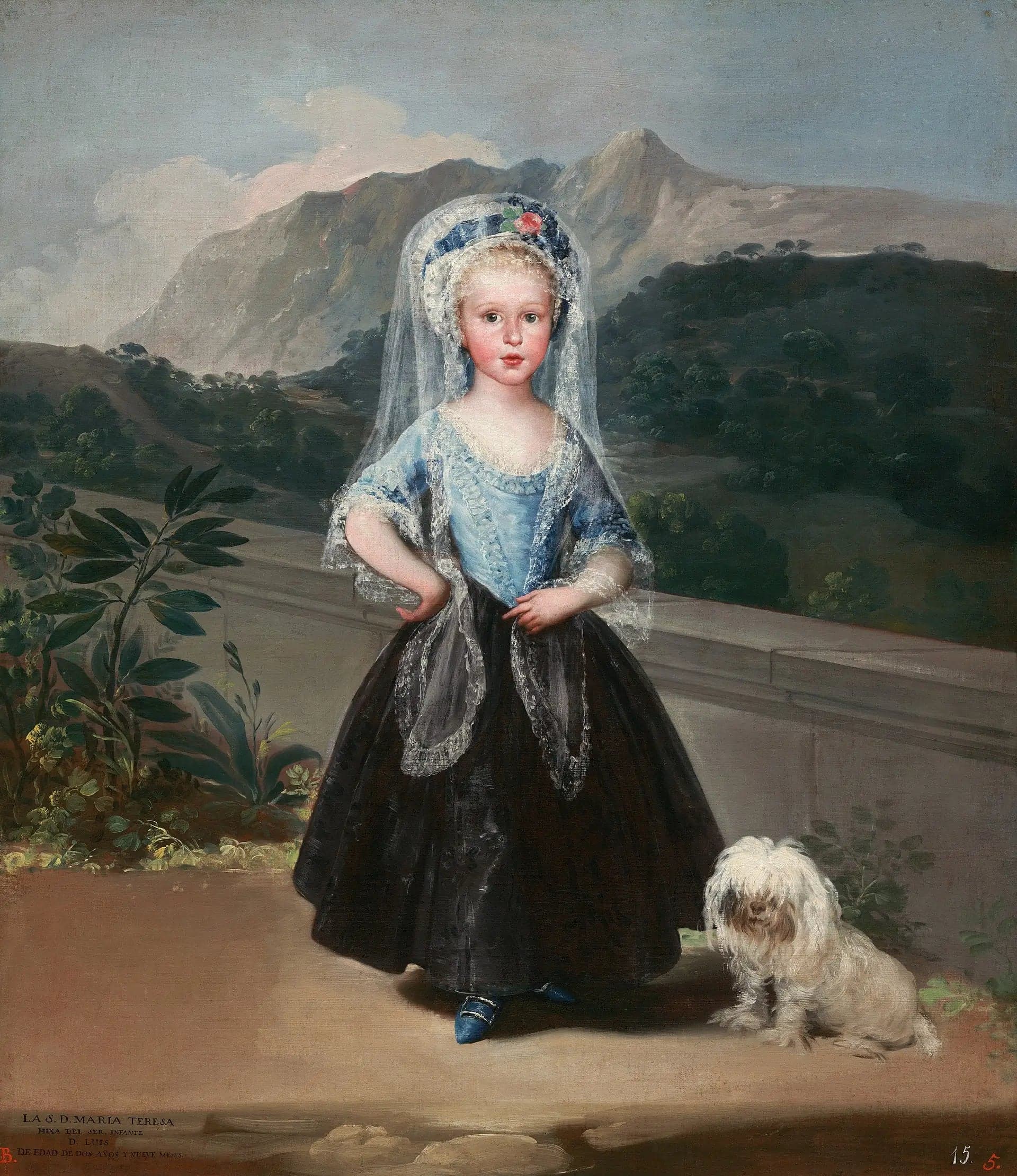
María Teresa de Borbón y Vallabriga, later Countess of Chinchón
- Original dimensions
- 117.5 x 134.5 cm
- Museum
- National Gallery of Art
- Year
- 1783
Scene depicted
This painting depicts María Teresa, dressed in a sumptuous gown, with a delicacy that transcends time. Her gaze, full of mystery and confidence, combined with a richly adorned environment, invites the viewer to explore the multiple facets of her personality. Goya, through his mastery of shadows and lights, vibrates the soul of the canvas , revealing extraordinary emotional depth.
Historical context
Created in 1783, this painting stands remarkably in Spanish history, precisely in Madrid, a city at the heart of cultural and political upheavals. Representing neoclassical art, Goya's work is distinguished by its pursuit of idealistic beauty, perfectly captured in this composition. Currently housed at the National Gallery of Art, this canvas embodies the essence of past eras through its impressive dimensions.
Place in the artist's career
This painting represents a turning point in Goya's career, marking the peak of his neoclassical style. Alongside La Maja Desnuda and Les Fusillades de Mai 1808 , this canvas bears witness to a technical evolution, moving from royal portraits imbued with formality to more human and emotional expressions.
Anecdote
Francisco de Goya once stated: “Art is the silent echo of our heart and our passions.” This quote finds its full meaning in the setting where he conceived this pictorial work . One spring morning, as the sun's rays gently caress María Teresa's face, Goya captured more than just a simple portrait; he managed to seize the essence of a soul.