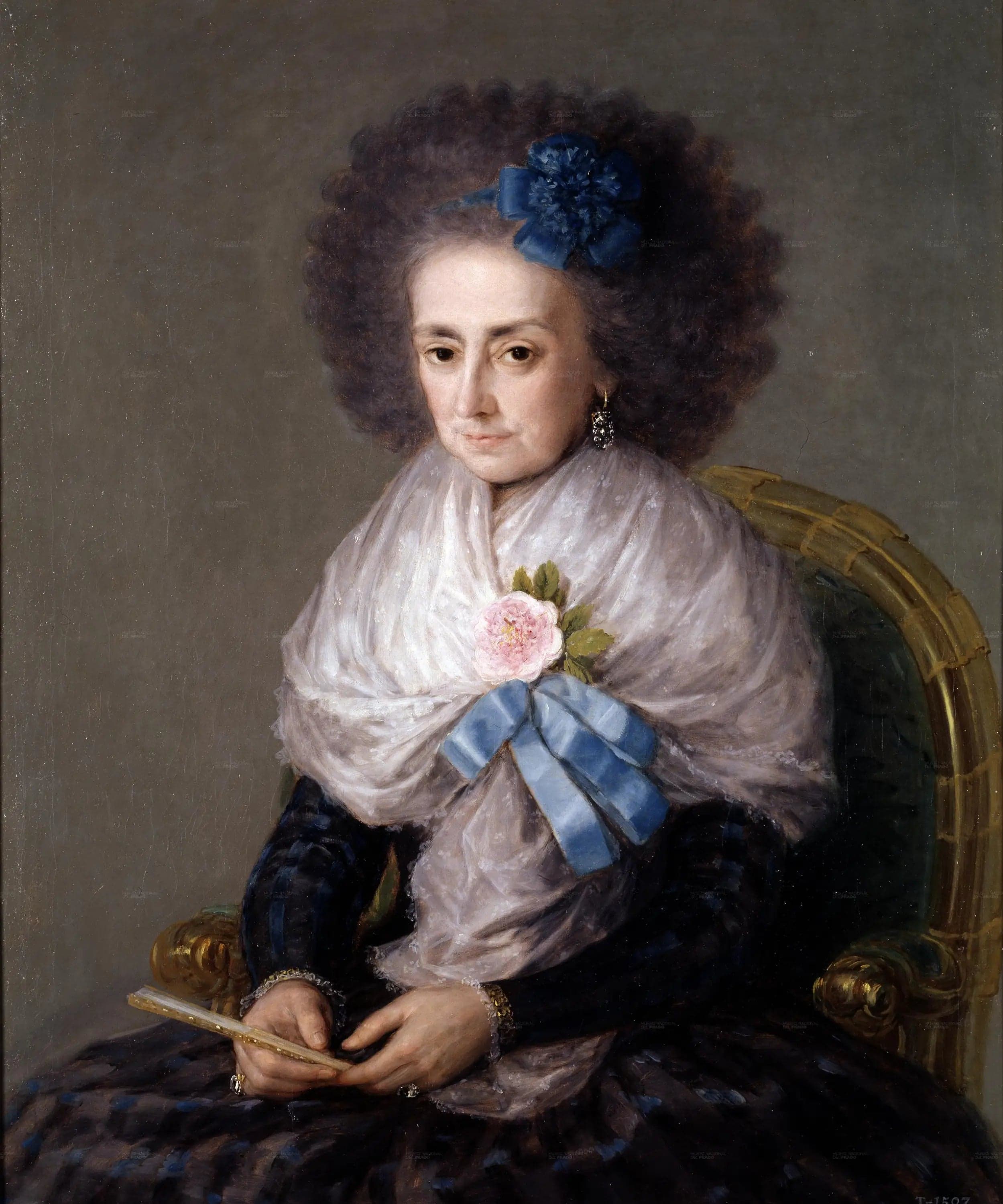
María Antonia Gonzaga, dowager marchioness of Villafranca
- Original dimensions
- 72 x 87 cm
- Museum
- Prado Museum
- Year
- 1795
Scene depicted
This painting depicts María Antonia Gonzaga, marquise douairière de Villafranca, frozen in a majestic pose, adorned with luxurious finery, and imbued with dignity. Goya succeeds in capturing not only the physical beauty of his model but also her spiritual aura, offering a portrait that transcends mere representation to become a tribute to the feminine nobility of her time.
Historical context
Created in 1795, this painting emblematic of Francisco de Goya transports us to Madrid, at the heart of 18th century Spain, a vibrant time when the artistic movement of romanticism began to emerge on the horizon. The painting is currently displayed at the prestigious Prado Museum, a sanctuary of art where the work continues to evoke the elegance and depth of a bygone era.
Place in the artist's career
Inscribed in Goya's career, this painting marks a milestone in his exploration of noble portraits. It reveals itself as both a stylistic peak, standing alongside masterpieces such as “La Maja Desnuda” and “The Family of Carlos IV,” a sign of an evolution marked by an intensification of emotion and an increasingly assertive technical mastery, hinting at the psychological depth of his subjects.
Anecdote
“Beauty lies in the invisible details,” Goya would say as he painted. Imagine him, at dawn, crossing a luminous silhouette through a fragrant garden, inspiration emerging like a warm spring breeze. This fleeting moment nourished the soul of his canvas , bringing to life the timeless grace of María Antonia Gonzaga.